
Uncategorized
How School Districts Run Cleaning Robots Every Night
A K-12 facilities director walkthrough. Where autonomous robots run, where custodians stay, and how the overnight schedule actually…
How hospitality operators evaluate, deploy, and scale commercial robots.
Tell us your industry and we'll recommend 3-4 robots to shortlist.
We evaluate, certify, and service every robot we sell.
From marketing, sales, demonstrations, and proof-of-concepts through deployment, training, support — and even repair. Local teams, local inventory, same-day service.
By Elad Inbar, RobotLAB founder & CEO — a practical guide to adopting robotics that actually delivers ROI.
About the book →RobotLAB CEO, Elad Inbar, explores 7 robotics trend predictions of 2026, including AI advances, computer vision, and the path to skilled trade automation.
%20(1).png)
By Elad Inbar, CEO, RobotLAB
If 2025 was the year robotics became core infrastructure, then 2026 will be the year that infrastructure starts running itself.
The next phase of robotics is not about flashier machines or louder announcements. It is about removing the remaining friction points that prevent robots from operating continuously, independently, and at scale. That shift will be driven by advances across hardware, software, AI, and system integration, not by any single breakthrough.
From where we sit, deploying and supporting robots in real environments every day, these are the trends that will define 2026.
One of the most important transitions we expect in 2026 is the move from “autonomous robots” to “self-sustaining robotic systems.”
Historically, even highly autonomous robots still depended heavily on human intervention. Brushes needed to be changed. Squeegees needed cleaning. Batteries needed manual charging. Water tanks needed refilling, and dirty water needed draining. These touchpoints limited scalability and increased operational overhead.
That is changing rapidly.
We are seeing robots paired with intelligent base stations that handle brush and squeegee cleaning, battery charging, fresh water refilling, and dirty water drainage automatically. When these systems are deployed correctly, robots can operate for extended periods with minimal human involvement. This transition fundamentally alters the economics of automation, especially in large facilities and multi-site operations.
In 2026, self-sustaining operation will move from premium capability to baseline expectation.
While software and AI attract most of the attention, hardware progress remains essential. In 2026, we expect continued improvements in durability, modularity, and serviceability across commercial robots.
Better motors, improved sensors, more resilient materials, and smarter mechanical design will reduce failure rates and extend operational life. These improvements may not generate headlines, but they directly impact uptime and total cost of ownership.
The robots that succeed will not be the most exotic. They will be the ones that can operate day after day, in imperfect environments, with predictable maintenance cycles.
Advances in chips and onboard compute will play a critical role in 2026. More powerful, energy-efficient processors will allow robots to run increasingly complex models locally, reducing reliance on cloud connectivity and lowering latency.
This matters because robotics lives in the physical world. Decisions must be made in milliseconds, not seconds. Improved compute enables better perception, smoother navigation, and faster recovery from unexpected conditions.
As compute becomes more capable and more affordable, intelligence will move closer to the robot, making systems more responsive, more reliable, and easier to deploy at scale.
AI progress in robotics will continue, but the emphasis will shift further away from novelty and toward robustness. The goal is no longer to prove what is possible in controlled settings. It is to ensure consistent performance in messy, real-world environments.
Better learning algorithms, improved generalization, and faster adaptation to new spaces will reduce setup time and ongoing tuning. Robots that can handle variation without extensive retraining will be far more valuable than those that require constant optimization.
In 2026, the most impactful AI will be invisible. It will simply make robots work better, faster, and more consistently.
Among all software advancements, improvements in computer vision will be the most critical to robotic success.
Robots operate in environments designed for humans, not machines. Understanding those environments accurately and reliably is essential. Advances in vision will allow robots to better recognize obstacles, surfaces, people, signage, and changes in layout.
Better vision enables safer operation, more efficient navigation, and more reliable task execution. It also reduces the need for artificial constraints, such as markers or highly structured environments.
In 2026, computer vision will increasingly determine which robots can scale and which remain confined to controlled settings.
One of the most underappreciated trends heading into 2026 is deeper integration between robots and buildings themselves.
Robots that can interface with elevators, doors, access control systems, charging infrastructure, and building management systems unlock entirely new workflows. These integrations reduce friction, expand coverage areas, and allow robots to operate across larger, more complex facilities.
True automation is not just about the robot. It is about the environment adapting to support it. In 2026, building integration will become a key differentiator between partial automation and full operational impact.
Humanoid robots will undoubtedly continue to advance in 2026. We expect more impressive demonstrations, better mobility, improved manipulation, and tighter integration with AI systems.
However, we do not expect broad commercial availability yet.
There are still significant challenges to resolve around cost, safety, reliability, maintenance, and integration into existing workflows. Humanoids must prove not just that they can perform tasks, but that they can do so economically, safely, and predictably over long periods.
The progress is real, and the direction is clear. But the remaining work should not be underestimated.
Looking further ahead, our view is that general-purpose service robots will eventually move into skilled trades.
At RobotLAB, we believe that by the end of this decade, we will see the first commercially viable robot plumber. That may sound ambitious, but the logic is straightforward.
Plumbing work follows structured rules. Pipes, fittings, valves, and diagnostics operate within defined constraints. As perception improves, manipulation becomes more precise, and AI models gain better understanding of physical systems, the path to automating skilled, repetitive service tasks becomes clearer.
The labor shortage in skilled trades is already severe and continues to worsen. When the economics align, automation will follow. The robot plumber is not science fiction. It is a question of sequencing and integration.
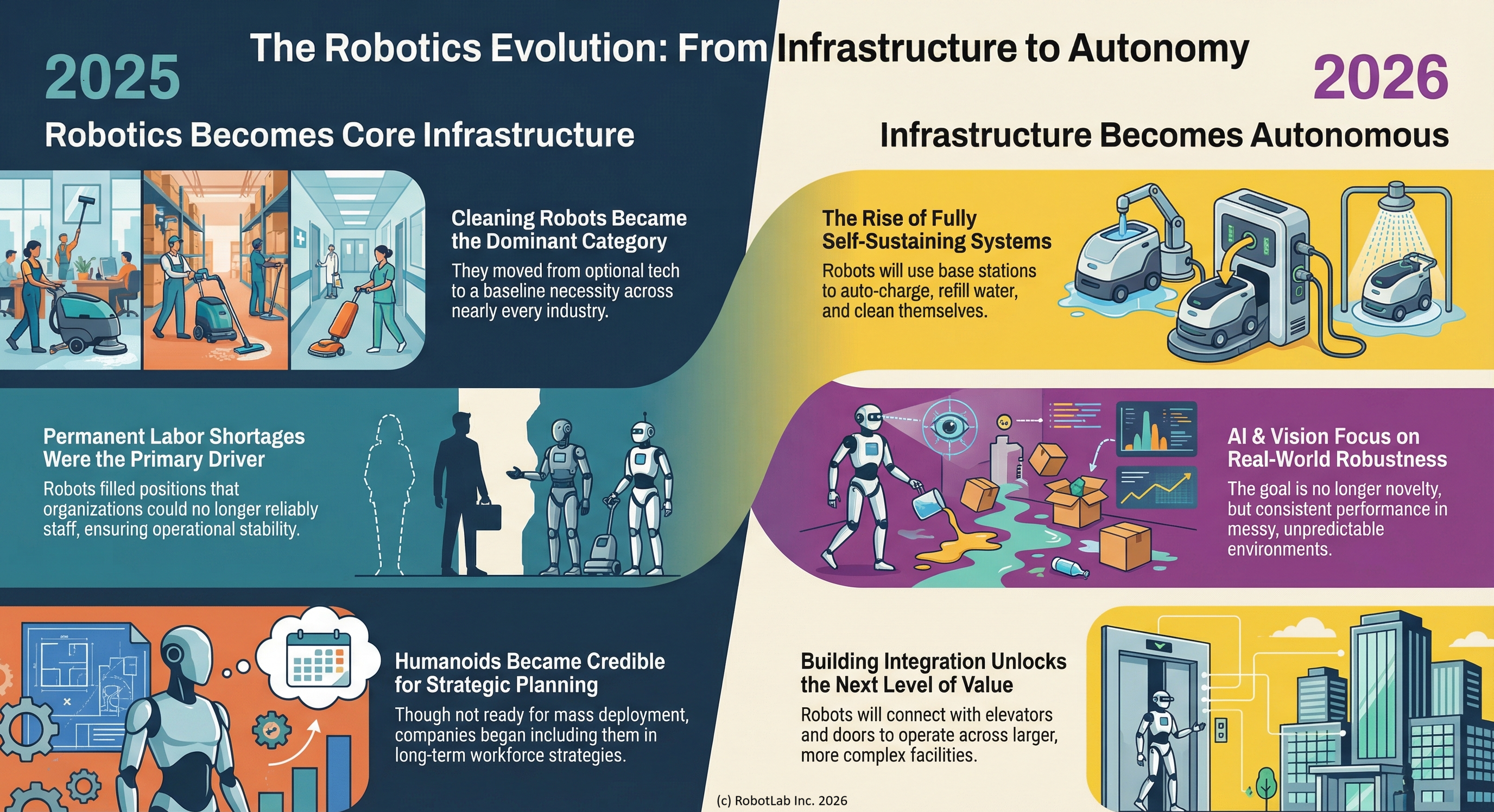
2026 will not be about robots doing entirely new things. It will be about robots doing existing things better, longer, and with less human intervention.
Self-sustaining operation, better compute, stronger AI, improved vision, and deeper building integration will collectively push robotics into its next phase. The result will be systems that are easier to deploy, easier to scale, and far more valuable operationally.
Humanoids will keep advancing, and the long-term future remains expansive. But the real progress in 2026 will come from making robots dependable infrastructure rather than experimental technology.
That is where the next wave of automation value will be unlocked.
A K-12 facilities director walkthrough. Where autonomous robots run, where custodians stay, and how the overnight schedule actually…
How K-12 districts add autonomous cleaning without a capital bond. Real district proof, per-scrubber capacity, and how to…
quick summary of what the content is
Lidia is an AI assistant. This conversation is stored and shared with the RobotLAB sales and support teams. Privacy policy
Chatting as · Not you?
You choose which categories of cookies are stored on your device. Strictly-necessary cookies are required for the site to function and cannot be disabled. Read more in our Privacy Policy.
Session, security, and the consent record itself. Required for the site to operate.
First-party tracking (Mautic, on t.robotlab.com) so we understand which pages and products visitors engage with and improve the site over time.
Advertising pixels (Google Ads, Meta Pixel) used to measure ad performance and show relevant ads on partner sites. Turning this off opts you out of CCPA "sale" of personal information.