
Education
How to Teach Ancient History in VR Without Building the Lesson Yourself
Building a history unit takes weeks. Greatest Civilizations gives K-12 and college instructors 50 ready-to-lead VR lessons, story…
How hospitality operators evaluate, deploy, and scale commercial robots.
Tell us your industry and we'll recommend 3-4 robots to shortlist.
We evaluate, certify, and service every robot we sell.
From marketing, sales, demonstrations, and proof-of-concepts through deployment, training, support — and even repair. Local teams, local inventory, same-day service.
By Elad Inbar, RobotLAB founder & CEO — a practical guide to adopting robotics that actually delivers ROI.
About the book →Credit feels far away on a worksheet. Stand in the Story: Financial Literacy puts students in households, workplaces, and markets, in 70 VR lessons.
Paychecks, credit, and insurance will matter for the rest of your students’ lives. On a worksheet, they can feel like someone else’s problem. The ideas are abstract, the stakes feel far away, and the examples rarely look like the households and workplaces students will actually walk into.
Stand in the Story: Financial Literacy makes them real. It is a complete, teacher-led VR course that puts students inside the places where money decisions happen.
The library has 70 lessons, 558 360° scenes, and 14 topics, written for you to lead. Topics include earning, budgeting, banking, credit, investing, insurance, business, and digital money, set in believable households and workplaces.
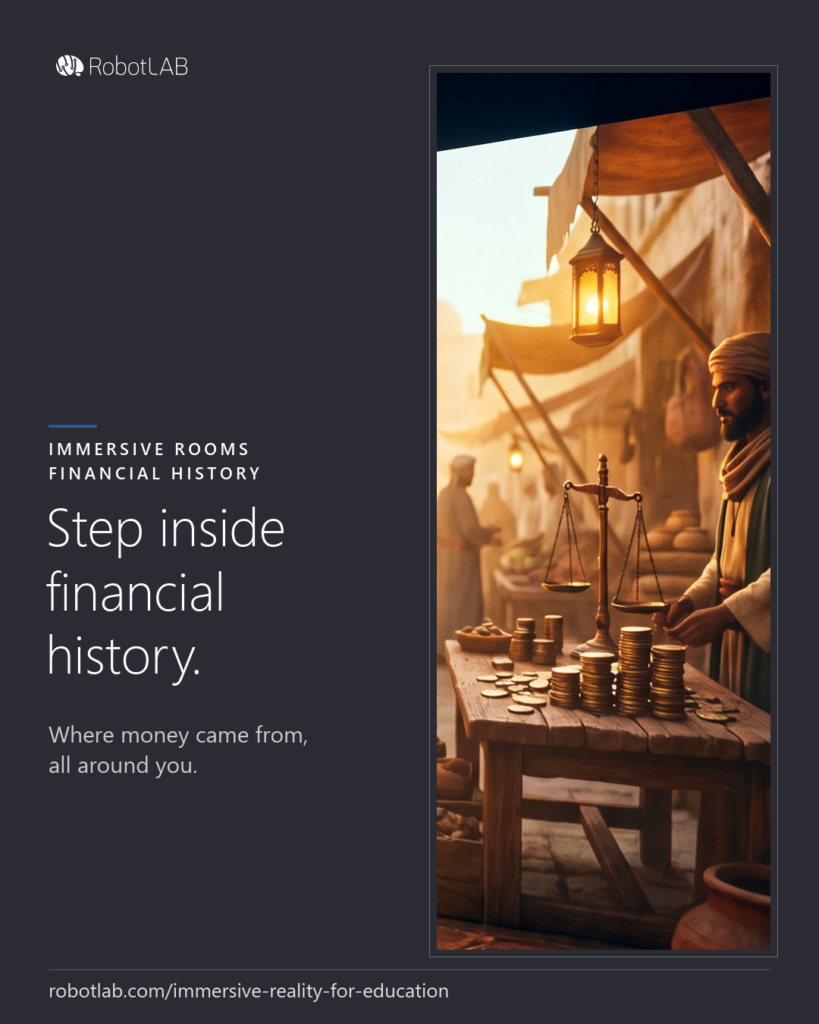
It also shows where money came from: the first coins, the silver mountain, the first share, and the trading floor. Students see that today’s paycheck sits at the end of a long story.
In “The Floor and the Screen,” your class stands in the open courtyard of the Exchange in Amsterdam, the Beurs built by Hendrick de Keyser over the Rokin. Merchants are meeting, deals are being struck, and the whole market is happening in one place at one time.
You read the story aloud and send students looking for the clues: who is trading, what is changing hands, and how anyone knows what something is worth. Then the class connects it to the screen-based markets of today.
Money is easier to understand when students can see the people and the setting around a decision. A budget means more inside a believable household with real bills on the table. Credit means more when students can see who is lending, who is borrowing, and what each one stands to lose. A market makes sense when students stand where buyers and sellers actually meet.
That is the idea behind every lesson in the library: put the class in the place, tell the story, and let students find the details that make the concept click.
Each scene comes with questions that climb from recall to argument, with answer guidance for you. A market scene supports a sequence like this (examples written for this post, not quoted from the lesson):
Paychecks, taxes, insurance, and credit arrive all at once when students start working. Standing inside a believable workplace and household gives them a picture to hold onto when those first decisions come, whether they are in high school or in their first year of college.
The same scenes carry four age pathways, so a lesson works for younger students and for seniors preparing for their first paycheck. In college courses, the top pathway focuses on source evaluation and argument, with sources listed for every lesson.
Every scene is a researched, AI-generated 360° reconstruction of a real place, and each lesson notes what is documented and what is staged.
One Android tablet for you and a Pico headset or a phone for each student. The tablet moves the whole class from scene to scene and holds the script, the clues, and the questions. It runs on the classroom network, or offline with the router in a RobotLAB VR kit. Hardware is sold separately, so whether you already own headsets or are starting from nothing, the RobotLAB team can tell you exactly what you would need.
See a full lesson in 15 minutes, or explore Stand in the Story. Already have VR headsets? The library runs on the hardware you already own if it uses an Android teacher tablet with Pico headsets or phones.
Stand in the Story is built by RobotLAB, bringing robotics and immersive learning to schools and colleges since 2007.
Earning, budgeting, banking, credit, investing, insurance, business, digital money, and more, across 14 topics and 70 lessons.
No. Each lesson has four K-12 age pathways, plus a source-evaluation pathway for college courses.
It runs on an Android teacher tablet with Pico headsets or phones. The RobotLAB team can check older kits.
Building a history unit takes weeks. Greatest Civilizations gives K-12 and college instructors 50 ready-to-lead VR lessons, story…
Compare Unitree R1, G1, and H2 for university teaching and research: size, degrees of freedom, sensing, compute, and…
Unitree sells most robots in standard and EDU editions. Here is what the difference means for university teaching…
Lidia is an AI assistant. This conversation is stored and shared with the RobotLAB sales and support teams. Privacy policy
Chatting as · Not you?
You choose which categories of cookies are stored on your device. Strictly-necessary cookies are required for the site to function and cannot be disabled. Read more in our Privacy Policy.
Session, security, and the consent record itself. Required for the site to operate.
First-party tracking (Mautic, on t.robotlab.com) so we understand which pages and products visitors engage with and improve the site over time.
Advertising pixels (Google Ads, Meta Pixel) used to measure ad performance and show relevant ads on partner sites. Turning this off opts you out of CCPA "sale" of personal information.