Education
What’s Actually Inside a K-12 AI Lab? (Hint: It’s Not Just a Room Full of Robots)
A K-12 AI Lab is more than robots. See the four categories of RobotLAB AI Labs, what students…
How hospitality operators evaluate, deploy, and scale commercial robots.
Tell us your industry and we'll recommend 3-4 robots to shortlist.
We evaluate, certify, and service every robot we sell.
From marketing, sales, demonstrations, and proof-of-concepts through deployment, training, support — and even repair. Local teams, local inventory, same-day service.
By Elad Inbar, RobotLAB founder & CEO — a practical guide to adopting robotics that actually delivers ROI.
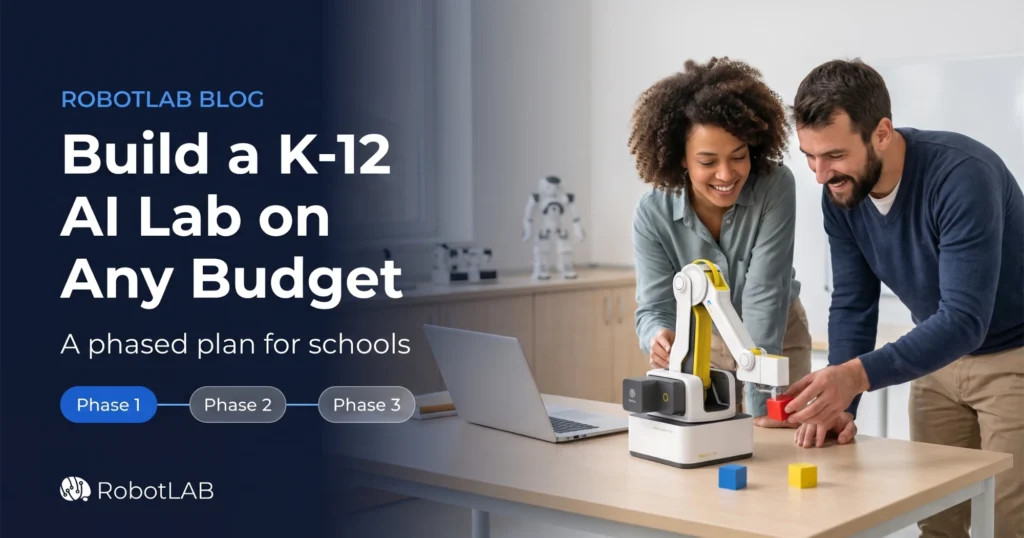
About the book →You don't need a full AI Lab budget to start. Here's a phased plan for planning, funding, and launching a K-12 AI and robotics lab, one category at a time.
Here’s something we hear a lot in planning conversations: “We love the idea of an AI Lab, but there’s no way we can fund the whole thing this year.”
That’s normal. In fact, it describes almost every school we work with.
The good news is that almost nobody builds a whole AI Lab at once. Most successful programs start with one focused category, prove it works with students, and expand as funding comes in. A phased plan is often the smarter way to build, and not just because it costs less up front.
Here’s how to plan one.
A phased approach does more than spread out the cost:
Every good AI Lab plan starts with one question: What should our students be able to do?
Answer that first and the right first phase usually becomes clear. Here’s how common goals map to the four categories of a RobotLAB AI Lab:
| If your goal is… | Start with… | Example platforms |
|---|---|---|
| Students who can code AI that sees, hears, and talks to people | Humanoid & AI Interaction | NAO, Pepper, Unitree G1 |
| Students ready for engineering and advanced robotics | Advanced Robotics & Mobility | Unitree Go2 |
| Graduates ready for automation and manufacturing careers | Automation & Manufacturing | Dobot Magician Lite, Dobot Mini Car Assembly Line |
| A complete, multi-discipline AI pathway in one space | Turnkey Lab Environment | RobotLAB AI & STEM Labs |
If you can only fund one category this year, pick the one closest to your strongest goal, whether that’s a CTE pathway, a new CS elective, or a flagship space for a new building.
Before anyone can give you a realistic plan or quote, you’ll need three things:
With those three answers, a lab specialist can recommend a realistic first phase, along with pricing and lead time, instead of a generic package.
This is where good plans most often fall apart.
Many schools fund labs through grants and categorical funds. Perkins V, for example, is commonly used for CTE equipment, and state and local STEM and workforce grants are another source. These funds usually come with spending deadlines. When the equipment decision stalls, one of two things tends to happen:
Either way, students lose a year of automation-ready, AI-ready learning.
The fix is to get your lab scoped, budgeted, and ready to deploy before the money is released. Ask your vendor for a quote written with grant justification in mind, so it can go straight into your application or budget. Check the specific rules on allowable expenses with your grants office or CTE director early.
A robot by itself isn’t a lab. When you compare options, make sure every quote covers:
Leaving any of these out is the most common reason labs go unused. It’s also where a cheap quote turns into an expensive problem.
Even if you’re only funding phase one, sketch out phases two and three now. A typical path might look like this:
A written roadmap makes each later funding request easier. You aren’t asking for something new each time. You’re asking to finish a plan that’s already working.
RobotLAB has been bringing robotics into education since 2007 and serves more than 32,000 customers worldwide. For schools, that means more than shipping equipment. We help with:
Whether you’re building this year or next, the planning can start now.
Tell us your goal and budget. We will recommend where to start, with a configuration, pricing, and lead time for your school.
Explore AI Labs →Turnkey labs with curriculum, installation, and teacher training included.
A K-12 AI Lab is more than robots. See the four categories of RobotLAB AI Labs, what students…
Discover how K–12 teachers are using AI to personalize learning, reduce paperwork, and spark creativity in the classroom.…
Discover how K–12 teachers are using AI to personalize learning, reduce paperwork, and spark creativity in the classroom.…
Lidia is an AI assistant. This conversation is stored and shared with the RobotLAB sales and support teams. Privacy policy
Chatting as · Not you?
You choose which categories of cookies are stored on your device. Strictly-necessary cookies are required for the site to function and cannot be disabled. Read more in our Privacy Policy.
Session, security, and the consent record itself. Required for the site to operate.
First-party tracking (Mautic, on t.robotlab.com) so we understand which pages and products visitors engage with and improve the site over time.
Advertising pixels (Google Ads, Meta Pixel) used to measure ad performance and show relevant ads on partner sites. Turning this off opts you out of CCPA "sale" of personal information.