
Warehouse
Floor Care For Electrical Distribution Centers: Automating The Work Around Your AS/RS
How electrical distributors use autonomous scrubbers to keep DC aisles, docks, and cut rooms clean every shift.
How hospitality operators evaluate, deploy, and scale commercial robots.
Tell us your industry and we'll recommend 3-4 robots to shortlist.
We evaluate, certify, and service every robot we sell.
From marketing, sales, demonstrations, and proof-of-concepts through deployment, training, support — and even repair. Local teams, local inventory, same-day service.
By Elad Inbar, RobotLAB founder & CEO — a practical guide to adopting robotics that actually delivers ROI.
About the book →How distributors pilot cleaning robots at one branch, measure hours returned, and roll out by region with RaaS.
The central distribution center (DC) usually gets the automation budget. Branch warehouses get whoever is free between counter rushes. For a distributor with dozens of branches, that gap means hours every week spent sweeping aisles, cleaning up after receiving, and keeping will-call areas presentable.
Autonomous cleaning robots close that gap one location at a time. Here is how to phase a rollout so every step pays for the next.
Choose a branch with steady receiving volume and a team that is already stretched. Avoid the newest or the smallest branch; the pilot should look like the network, so the result carries over.
For two weeks, log the hours staff spend on floor care and who spends them. Note which tasks get delayed when someone is cleaning: counter coverage, receiving, order prep.
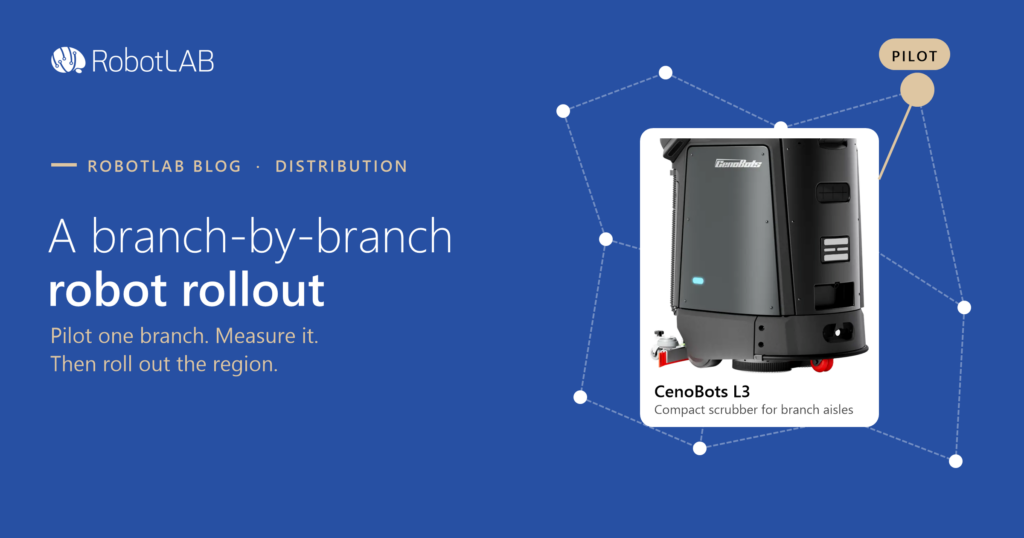
A compact autonomous scrubber like the CenoBots L3 is built for tight aisles and corridors, which fits most branch warehouses. RobotLAB maps the floor, sets the cleaning schedule by zone, and trains the team in a single deployment.
Compare the hours against the baseline. The hours your team gets back shift to the counter, the cut room, and order prep, and they are the number your regional managers and finance team will care about.
Once one branch proves out, roll the same robot model to the rest of the region. A single model means one training program, one parts list, and one schedule template, and branch managers can compare results across sites.
Robots-as-a-Service (RaaS) bundles hardware, software, and service into one monthly fee on a 36-month term. Each branch carries a predictable operating cost, and the rollout stays off the capital budget. Financing and purchase options are available for distributors who prefer to own the asset.
Larger DC floors call for larger machines, and autonomous mobile robots (AMRs) such as the Pudu T300 handle material moves between zones. A branch rollout and a DC deployment can run on the same service agreement.
| Phase | Scope | Decision point |
|---|---|---|
| Pilot | One branch, one compact scrubber | Hours returned at 60 days vs baseline |
| Region | Every branch in the pilot’s region, same model | Consistency across sites, service response |
| DC | Large scrubber on main DC aisles; AMR route if the walkthrough finds one | Payback on DC inputs |
| Network | Remaining regions on the same schedule template | Budget path: RaaS or purchase |
This is a planning sequence, not a fixed timeline. Each phase starts when the one before it has a result.
Branches are where floor care competes most directly with customer work. One robot, one baseline, and one region at a time turns that into a measured rollout instead of a network-wide bet.
Book A Free Walkthrough · Run The Cleaning Robot ROI Calculator
How electrical distributors use autonomous scrubbers to keep DC aisles, docks, and cut rooms clean every shift.
Where autonomous mobile robots fit in an electrical distribution DC: receiving, cut room, staging, and will-call moves.
Lidia is an AI assistant. This conversation is stored and shared with the RobotLAB sales and support teams. Privacy policy
Chatting as · Not you?
You choose which categories of cookies are stored on your device. Strictly-necessary cookies are required for the site to function and cannot be disabled. Read more in our Privacy Policy.
Session, security, and the consent record itself. Required for the site to operate.
First-party tracking (Mautic, on t.robotlab.com) so we understand which pages and products visitors engage with and improve the site over time.
Advertising pixels (Google Ads, Meta Pixel) used to measure ad performance and show relevant ads on partner sites. Turning this off opts you out of CCPA "sale" of personal information.