
Warehouse
A Branch-By-Branch Robot Rollout For Electrical Distributors
How distributors pilot cleaning robots at one branch, measure hours returned, and roll out by region with RaaS.
How hospitality operators evaluate, deploy, and scale commercial robots.
Tell us your industry and we'll recommend 3-4 robots to shortlist.
We evaluate, certify, and service every robot we sell.
From marketing, sales, demonstrations, and proof-of-concepts through deployment, training, support — and even repair. Local teams, local inventory, same-day service.
By Elad Inbar, RobotLAB founder & CEO — a practical guide to adopting robotics that actually delivers ROI.
About the book →How electrical distributors use autonomous scrubbers to keep DC aisles, docks, and cut rooms clean every shift.
Electrical distributors are spending heavily on automation. Van Meter is adding 124,000 sq ft and Hai Robotics automation to its Cottage Grove, MN distribution center. Codale, a Sonepar company, opened an AutoStore-equipped distribution center (DC) in Las Vegas in October 2025.
Those systems automate storage and picking, the work of an automated storage and retrieval system (AS/RS). The floor they sit on still gets cleaned the old way: an associate, a broom or a ride-on machine, and whatever time is left after receiving and counter traffic. This article covers where that time goes and how autonomous scrubbers take it back.
Floor care on an electrical distribution floor concentrates in four zones:
Each zone gets cleaned when someone has time. On a busy day, that is late, partial, or skipped.
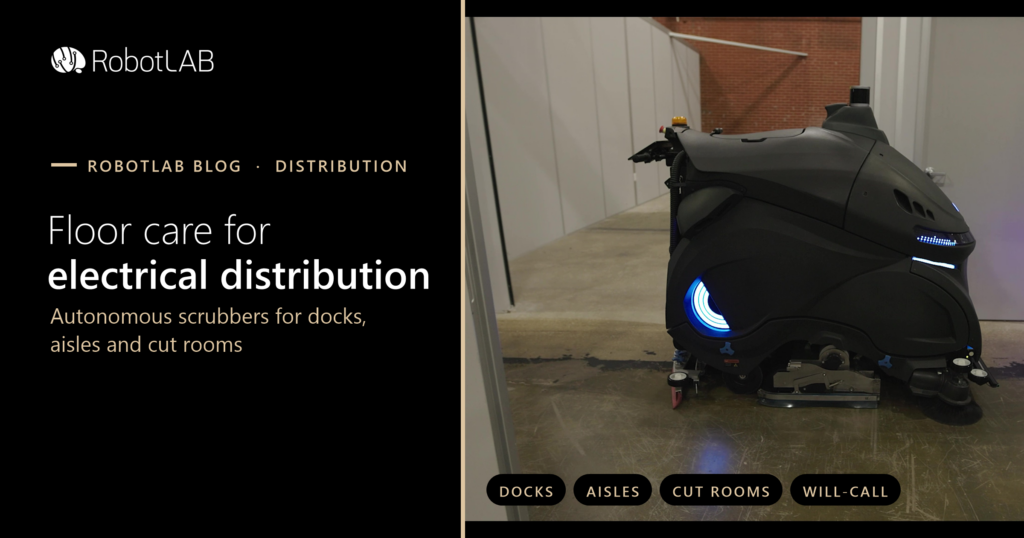
Autonomous scrubbers and sweepers map the facility once, then run scheduled routes by zone. They use LiDAR and 3D sensing to detect and stop for people, forklifts, pallets, and unexpected obstructions, and they dock to recharge or refill and resume on their own.
Most sites mix two modes. Some zones run during open hours alongside staff and equipment; others run unattended after close when the floor is clear. Scheduling is set per zone and per shift during deployment.
Robot choice follows the floor:
The right mix comes from walking the floor, not from a catalog. Floor type, traffic, and square footage per zone decide it.
RobotLAB robots have cleaned more than 256 million square feet across warehouse and DC operations. One regional distribution center deployed a Scrubber 75 across 400,000 sq ft and reached ROI in 11 months on labor savings, with its cleaning crew moved to detail work.
That result is one site with one robot. Your payback depends on your square footage, your current hours, and your wage rate, which is why every walkthrough ends in an ROI model built on your own inputs.
Before any robot arrives, measure three things for two weeks:
Those numbers become the before-and-after for the pilot.
Pick the zone that eats the most hours, deploy one robot, and measure again after 60 days. The hours returned are the number your operations and finance teams will care about. Once one zone proves out, the next zone or the next site follows the same playbook.
RobotLAB owns the last mile: assessment, robot selection, deployment, mapping, scheduling, staff training, software updates, and ongoing service. Your team does not have to learn robotics to run a robot fleet.
Automation investment in electrical distribution is moving fast at the storage and picking layer. The floor around it is the next place to take hours back. Start with one zone, measure it, and scale.
Run your numbers in the Cleaning Robot ROI Calculator or Book A Free Walkthrough.
How distributors pilot cleaning robots at one branch, measure hours returned, and roll out by region with RaaS.
Where autonomous mobile robots fit in an electrical distribution DC: receiving, cut room, staging, and will-call moves.
Lidia is an AI assistant. This conversation is stored and shared with the RobotLAB sales and support teams. Privacy policy
Chatting as · Not you?
You choose which categories of cookies are stored on your device. Strictly-necessary cookies are required for the site to function and cannot be disabled. Read more in our Privacy Policy.
Session, security, and the consent record itself. Required for the site to operate.
First-party tracking (Mautic, on t.robotlab.com) so we understand which pages and products visitors engage with and improve the site over time.
Advertising pixels (Google Ads, Meta Pixel) used to measure ad performance and show relevant ads on partner sites. Turning this off opts you out of CCPA "sale" of personal information.