
Warehouse Automation in Miami: How Autonomous Mobile Robots Are Solving the Real Labor Problem in South Florida Distribution Centers
Jun 2, 2026
The real issue is not a labor shortage. It is how your labor is being used.
In warehouses and distribution centers across Miami and South Florida, the conversation around labor continues to dominate operational strategy. Hiring is harder. Retention is inconsistent. Wages and benefits are rising. But the most effective operations leaders are asking a different question:
Are we using the workforce we already have in the most valuable way possible?
In many Miami warehouses, the real problem is not a lack of people. It is a misallocation of their time.
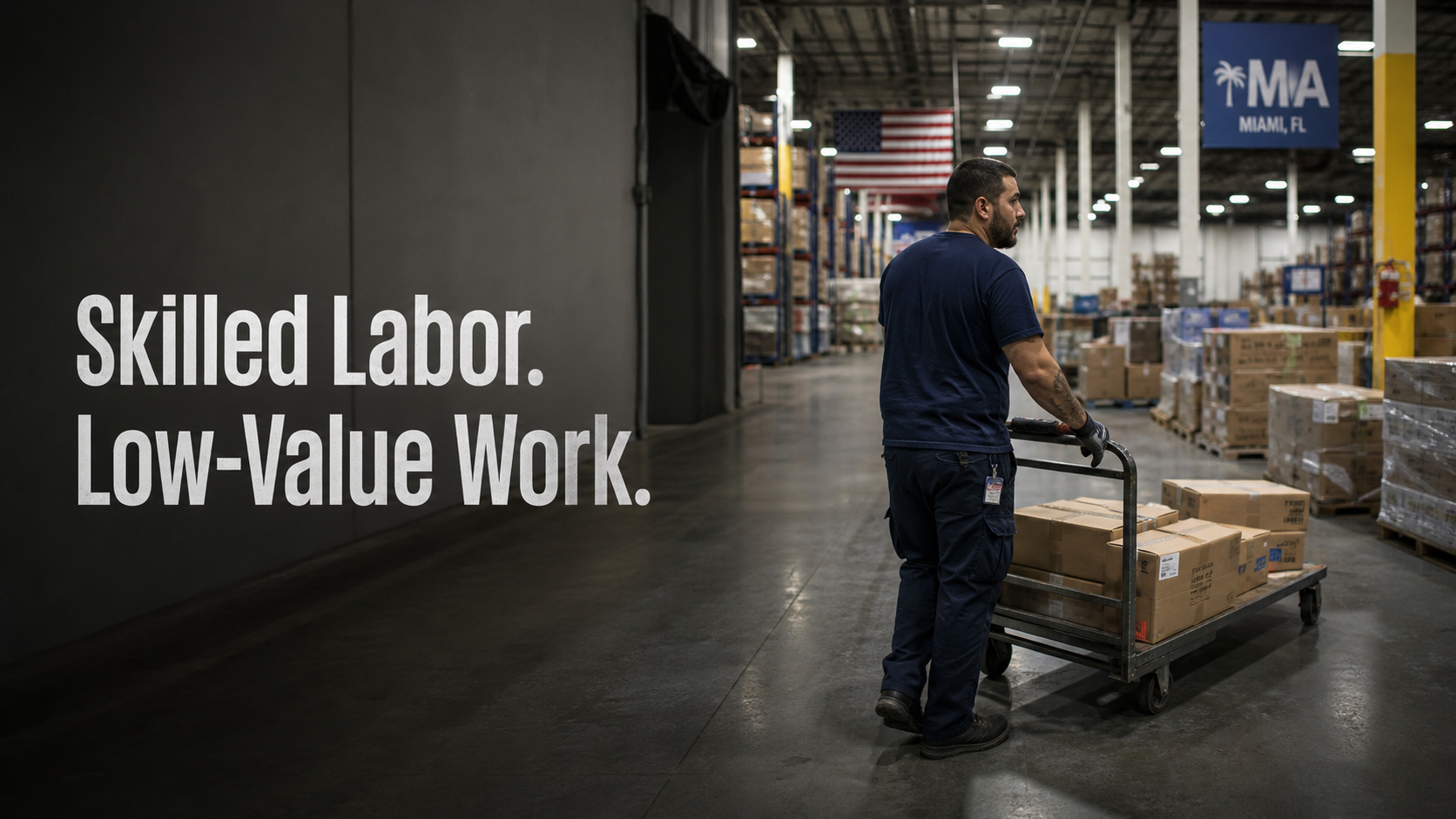
Skilled warehouse labor is being consumed by low-value work
Walk almost any warehouse in Miami-Dade, Broward, or along the Doral and Medley logistics corridor and the same pattern shows up: highly capable workers performing tasks that require little to no decision-making.
- Moving materials between zones
- Repeating predictable transport routes between receiving, staging, and pick paths
- Handling internal logistics that do not require skill or judgment
- Walking long distances between pick faces and pack stations
These tasks are necessary. They are not high-value tasks. And when skilled labor is tied up in repetitive movement, the operation loses efficiency exactly where it matters most.
The cost is not visible on the P&L, but it is significant
Most warehouses do not measure how much time is spent on repetitive material movement. The impact shows up downstream, in performance metrics that operations leaders watch every week:
- Slower order processing and longer order-to-ship cycle times
- Reduced throughput per labor hour
- Limited capacity to scale during peak seasons without aggressive hiring
- Higher overtime spend to absorb volume spikes
The takeaway: nearly half of your workforce capacity may not be driving meaningful output. It is being spent on transport.
Hiring does not solve a misallocation problem
When productivity drops, the default response in Miami warehouses is to hire more people. Adding labor to an inefficient structure does not increase efficiency. It increases cost.
- More people performing the same low-value tasks
- Increased operational complexity, supervision, and training overhead
- Higher fully-loaded labor cost without proportional output gains
- Continued vulnerability to turnover and seasonal hiring competition
"If your best people are doing your lowest-value tasks, the problem is not capacity. It is allocation."
Alberto Marcano, Branch President, RobotLAB Miami
High-performing warehouse operations protect skilled labor
The strongest distribution centers and 3PL operations in South Florida think about labor differently. They do not just manage it. They protect it.
- Assigning people to tasks that require judgment, dexterity, or quality control
- Reducing time spent on repetitive, predictable internal movement
- Structuring workflows to maximize human impact on picking accuracy, packing quality, and exception handling
The goal is not to work harder. It is to work smarter with the team you already have.
Warehouse automation unlocks workforce potential
This is where leading distribution centers and warehouses in Miami are making a strategic shift. Instead of using human labor for repetitive internal transport, they are introducing autonomous mobile robots (AMRs) into the workflow where it makes the most operational sense:
- Moving totes, bins, and pallets between receiving, storage, and pick zones
- Running predictable, repeatable transport routes that previously consumed pickers and floor staff
- Supporting goods-to-person workflows during peak hours
- Operating continuously across first, second, and third shifts
The operational result is consistent across Miami warehouses that have made the shift:
- Repetitive transport is handled consistently and predictably
- Skilled employees focus on picking, packing, QA, and exception handling
- Overall productivity rises without increasing headcount
- Peak-season volume is absorbed without proportional hiring
Autonomous warehouse robots are not about replacing people. They are about elevating how people contribute on the floor.
From labor consumption to labor optimization
The transformation is clear:
- From using labor everywhere to using labor where it matters most
- From repetitive execution to skilled contribution
- From capacity constraints during peak to unlocked, scalable throughput
This shift does not require more hiring. It requires better allocation.
In Miami logistics, workforce strategy is the competitive advantage
South Florida is one of the most competitive logistics environments in the country. PortMiami, Port Everglades, MIA cargo, the Doral and Medley industrial corridors, and the e-commerce fulfillment buildout across Broward and Palm Beach all compete for the same labor pool. How you use that labor defines your performance.
When repetitive transport no longer consumes your skilled workforce:
- Throughput per labor hour increases
- Labor cost per unit stabilizes
- Operations become scalable for seasonal and e-commerce volume spikes
- You compete for talent on the strength of the work, not the strain of it
That is the moment when labor stops being a constraint and becomes a competitive advantage.
Frequently asked questions about warehouse automation in Miami
What is warehouse automation, and how does it apply to a Miami warehouse?
Warehouse automation uses autonomous mobile robots (AMRs), automated guided vehicles, conveyor systems, and warehouse management software to handle repetitive material movement and storage. For Miami distribution centers, the most common starting point is AMRs handling internal transport between receiving, storage, and pick zones, where labor is currently spent walking instead of picking.
How quickly can a Miami warehouse deploy autonomous mobile robots?
Most South Florida warehouses move from facility walkthrough to first AMR running on the floor within 45 to 60 days. RobotLAB Miami handles facility mapping, integration with your WMS or pick workflow, operator training, and first-line support.
How does a 3PL or distribution center justify the investment in warehouse robots?
The most common ROI drivers are labor hours redirected from transport to picking and packing, reduced overtime during peak, lower turnover among skilled pickers, and increased throughput per square foot. Robot-as-a-Service (RaaS) options move the cost from capital expense to a per-month operating line, which shortens payback for most Miami operators.
Will autonomous robots replace warehouse workers?
No. AMRs handle repetitive internal transport. Picking, packing, quality control, exception handling, and supervision remain human work. The result is fewer hours spent walking and more hours spent on tasks that drive accuracy and throughput.
Do warehouse robots integrate with existing WMS and ERP systems?
Yes. Modern AMR platforms integrate with common WMS, WES, and ERP systems through standard APIs, including Manhattan, Blue Yonder, NetSuite, SAP, and most mid-market WMS platforms used by Miami 3PLs. RobotLAB Miami scopes the integration during the initial walkthrough.
What types of Miami warehouses are using autonomous robots today?
Adoption is growing across 3PL operators, e-commerce fulfillment centers, food and beverage distribution, building products distribution, and traditional manufacturing-attached warehouses throughout Miami-Dade, Broward, and Palm Beach. RobotLAB Miami supports deployments from single-building operations to multi-facility distribution networks.
Ready to redirect your Miami warehouse labor toward higher-value work?
If you are evaluating how to increase productivity without increasing headcount, this is the moment to see how autonomous mobile robots can fit into your warehouse or distribution center.
Schedule a 15-minute strategic conversation with RobotLAB Miami
See how warehouse and distribution leaders across Miami and South Florida are transforming internal operations by reallocating labor toward higher-value work, absorbing peak volume without proportional hiring, and turning workforce strategy into a measurable competitive advantage.







 Too much to read? Don't have time?

.webp?width=124&height=124&name=image%20(1).webp)
.webp?width=169&height=87&name=image%20(2).webp)