-1.png)
Firia Labs CodeAir
A camera-equipped autonomous coding drone that teaches real Python, computer vision, and machine learning to grades 6-12 — deployed and supported nationwide by RobotLAB.
- Manufacturer
- Firia
- Capability
- AI Labs, Coding & AI, Innovation Labs, STEM Education
- Support
- US sales, setup & service
Overview
What is the Firia Labs CodeAir?
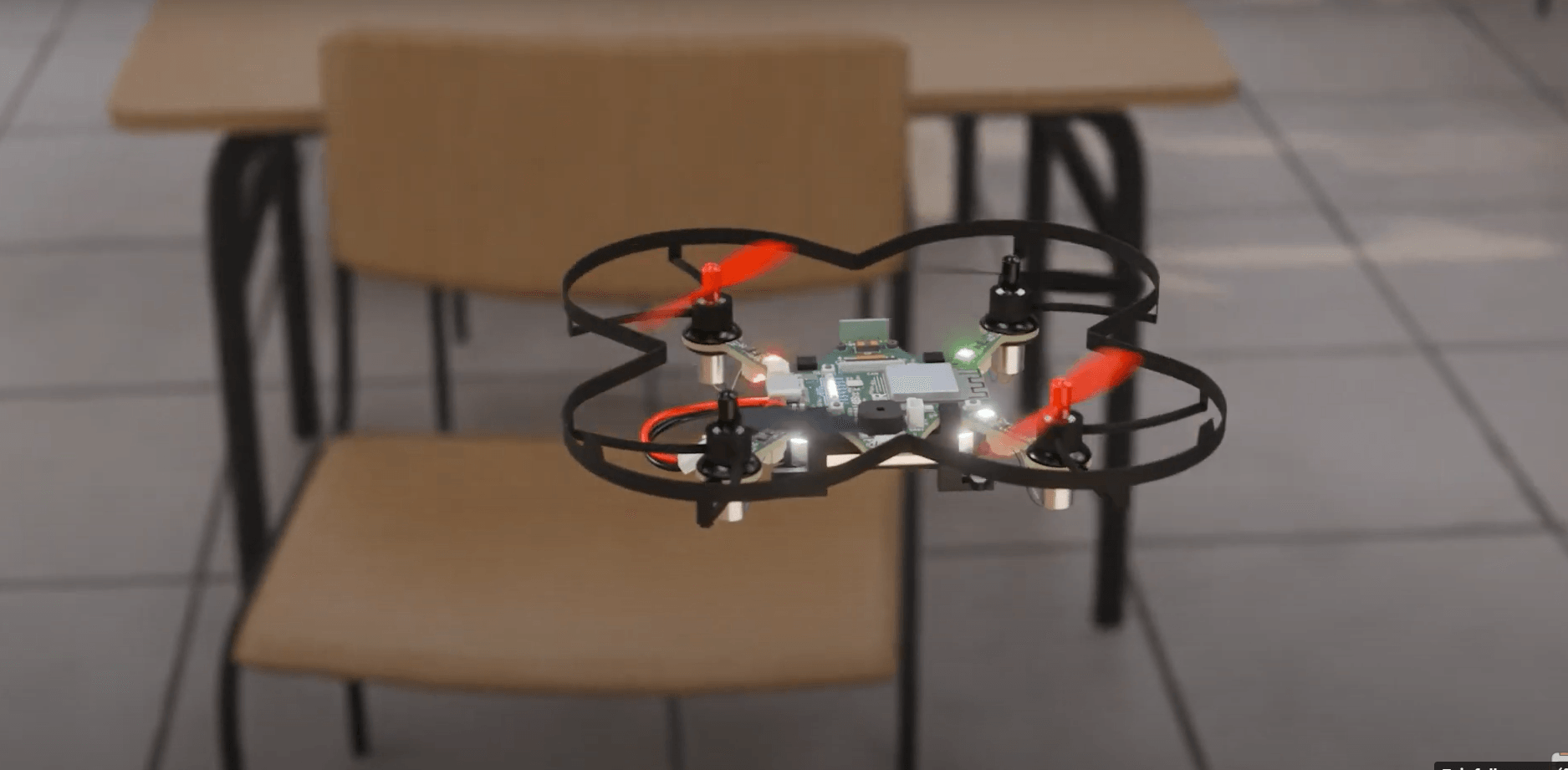
The Firia Labs CodeAIR is an educational quadcopter built to teach text-based Python programming through autonomous flight. Unlike a remote-controlled toy drone, the CodeAIR is flown entirely by student-written code: learners program takeoff, hovering, waypoint navigation, and landing, then layer on camera-based sensing and AI. Two processors work in tandem — an ESP32 runs the student's Python program while an STM32F405 flight controller (running the open-source Crazyflie firmware) handles stable, safe flight — so beginners get responsive, forgiving behavior while writing genuine code. RobotLAB resells the CodeAIR at $299 and supports schools and districts with procurement, classroom rollout, and ongoing service.
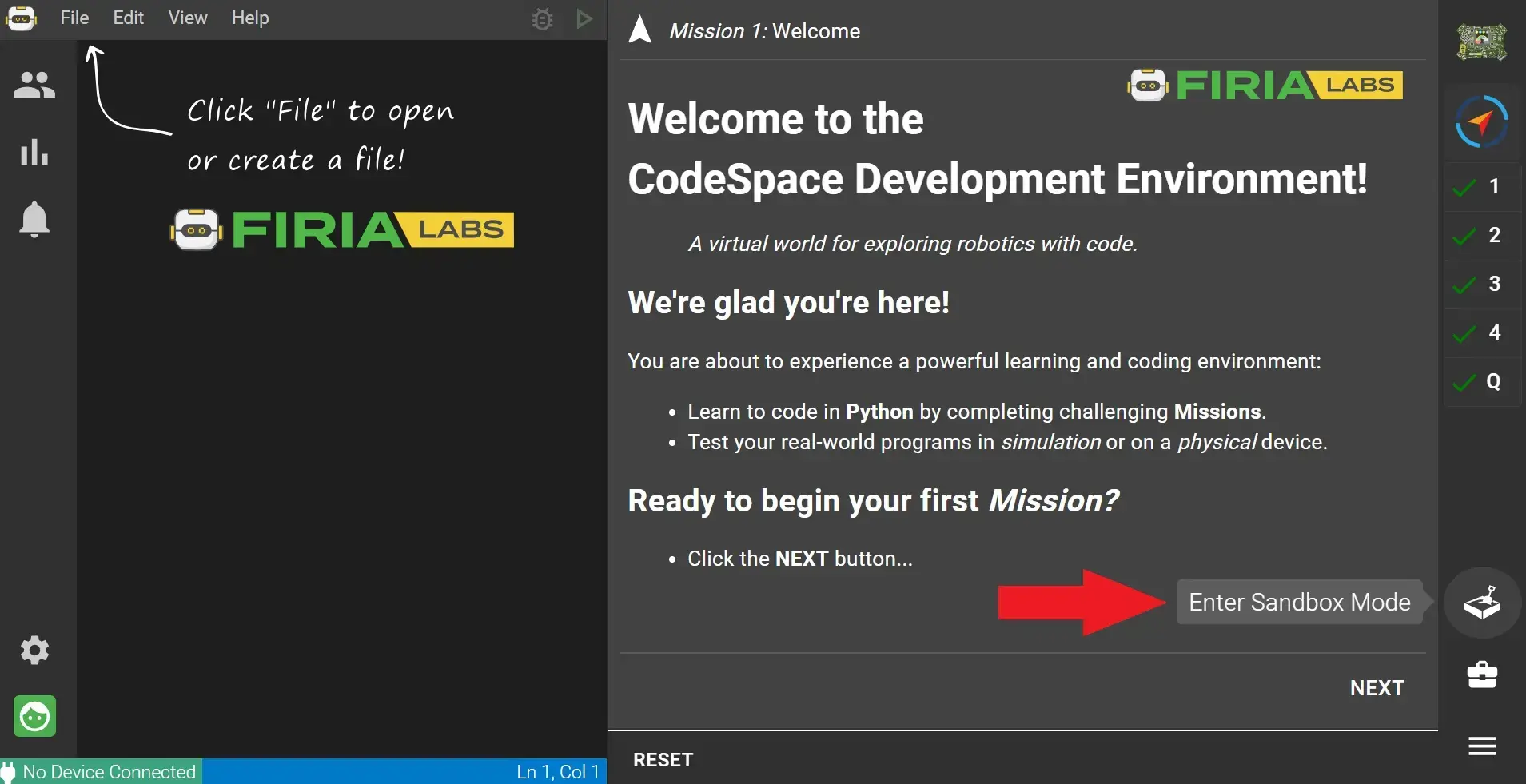
The kit pairs the assembled drone with Firia Labs' CodeSpace platform — a browser-based professional-class Python IDE and interactive digital textbook — and the 12-mission "Fly with Python" curriculum (87 objectives, 27 quizzes). Onboard hardware includes an OV2640 color camera that live-streams into the CodeSpace IDE, a 6-DOF IMU, barometric altimeter, magnetometer, up/down/front time-of-flight laser rangers, and an optical ground-tracking flow sensor for position hold. An onboard AI accelerator runs TensorFlow Lite, letting students move from basic flight commands into computer vision and machine-learning projects with real sensor data.
As a reseller and integrator rather than the manufacturer, RobotLAB positions the CodeAIR for educators who want an affordable, single-student or pair entry point into Python and applied AI. It complements floor robots and block-coding kits already in many STEM labs by adding the engagement of flight and the rigor of text-based coding. RobotLAB can supply CodeAIR as individual kits or scale it across a classroom, and bundles it with onboarding, curriculum-license guidance, and U.S.-based support.
Specifications
Key specs
| Product Type | Educational autonomous coding drone (quadcopter) |
| Brand / Manufacturer | Firia Labs |
| Target Grades | 6-12+ |
| Users per Kit | 1-2 students |
| Programming Language | Python (CircuitPython) |
| IDE / Platform | CodeSpace (web-based Python IDE + interactive textbook) |
| Included Curriculum | Fly with Python — 12 missions, 87 objectives, 27 quizzes |
| Curriculum License | 1-year CodeSpace license (renewal sold separately) |
| Application Processor | ESP32 (runs student Python code) |
| Flight Controller | STM32F405 running open-source Crazyflie firmware |
| AI Engine | Onboard AI accelerator running TensorFlow Lite |
| Camera | OV2640 color CMOS UXGA sensor, 1632 x 1232, live stream to IDE |
| Motion Sensors | BMI088 3-axis accelerometer/gyroscope (6-DOF IMU) |
| Altimeter | BMP390 high-precision barometric altimeter |
| Magnetometer | QMC5883 3-axis magnetometer |
| Range Sensors | VL53L1CX time-of-flight laser rangers (up / down / front) |
| Optical Flow | PMW3901 ground-tracking flow sensor (position hold) |
| Indicators | 8 RGB NeoPixels (4 top, 4 bottom) + 8 blue indicator LEDs |
| Connectivity | 2.4 GHz radio, infrared transceiver, QWIIC expansion port, SD card storage |
| Battery | 600 mAh rechargeable LiPo |
| Charging | USB-C with onboard LiPo charger |
| Weight | 55 g |
| Dimensions (W x H x D) | 130 x 130 x 35 mm |
| Device Compatibility | Chromebook / web-based (CodeSpace) |
| Purchase Price | $299 |
How it works
Firia Labs CodeAir in detail
Middle & High School Computer Science (K-12)
The CodeAIR targets grades 6-12+ as a hands-on Python course. Students progress through 12 scaffolded missions in the included "Fly with Python" curriculum, writing real CircuitPython/Python in a professional-class web IDE rather than dragging blocks. Flight provides immediate, motivating feedback for abstract concepts like loops, conditionals, and functions, and built-in height and distance safety limits keep classroom flying manageable.
Applied AI & Computer Vision Labs
The onboard OV2640 camera streams live video into CodeSpace, and the AI accelerator runs TensorFlow Lite. That lets teachers build units on computer vision and machine learning — image capture, object sensing, and training simple models — using a physical device students can see respond. This suits schools wanting an introductory AI pathway without standing up a separate ML hardware lab.
Higher-Ed & Maker / Outreach Programs (Higher-Ed)
University intro-programming sections, education-department methods courses, and campus outreach or summer camps can use the CodeAIR as a low-cost, self-contained autonomous-flight platform. Because it uses standard Python and an open-source flight controller, it bridges classroom coding and real robotics/UAV concepts. RobotLAB can supply units in quantity with consistent configuration and support for multi-section deployments.
Compare
How the Firia Labs CodeAir compares
See it in action
Firia Labs CodeAir in the field
What's included
In the box
- CodeAIR Drone
- USB-C Cable
- Fly with Python Curriculum Access
- One-Year Floating License
- Teacher Resources
Talk to a specialist
Get pricing & a free demo of the Firia Labs CodeAir.
Same-day response. We handle delivery, on-site setup, staff training, and ongoing service nationwide.
Questions & answers
About the Firia Labs CodeAir.
-
Is the CodeAIR a remote-controlled drone?
No. The CodeAIR is flown by student-written Python code, not a handheld remote. Learners program takeoff, hovering, waypoint navigation, and landing in the CodeSpace IDE. An optional CodeX controller can be programmed by students to send commands, but the core experience is autonomous, code-driven flight. Call 1-87-RobotLAB if you'd like the CodeX controller option quoted alongside the kit.
-
What programming language and platform does it use?
It uses real Python (CircuitPython) inside CodeSpace, Firia Labs' browser-based professional-class IDE and interactive digital textbook. The kit includes the 12-mission "Fly with Python" curriculum and a 1-year CodeSpace license. It runs on Chromebooks and standard web browsers, so most school devices work without extra software.
-
What's included for the $299 RobotLAB price?
The kit includes the assembled CodeAIR drone, a 600 mAh rechargeable battery, a USB-C cable, the "Fly with Python" curriculum, and a 1-year CodeSpace license. License renewals and replacement parts are sold separately. For current bundle pricing, volume discounts, or quotes including the CodeX controller, call 1-87-RobotLAB.
-
Can students do AI and computer vision with it?
Yes. The onboard OV2640 camera live-streams into CodeSpace, and an onboard AI accelerator runs TensorFlow Lite. Students can capture and process images in Python and build introductory computer-vision and machine-learning projects using real sensor data from a flying device.
-
How many students can use one CodeAIR?
Firia Labs recommends 1-2 students per kit. For classroom or whole-grade deployments, RobotLAB can supply CodeAIR units in quantity with consistent configuration. Call 1-87-RobotLAB to scope the right number of kits and curriculum licenses for your class size.
-
How does RobotLAB support the purchase?
RobotLAB is a U.S.-based reseller and robotics integrator, not the manufacturer. We handle procurement (including POs and quotes), classroom rollout guidance, curriculum-license setup, and ongoing support. Reach our team at 1-87-RobotLAB to get started or to compare the CodeAIR against other coding robots in our catalog.
-
What's the difference between CodeAIR and CodeBot?
Both are Firia Labs devices that teach Python in the same CodeSpace platform. The CodeBot is a wheeled floor robot (proximity/line sensors, encoders) for grades 7+, while the CodeAIR is a flying drone with a camera and AI accelerator for grades 6+. Many schools start with one and add the other. Call 1-87-RobotLAB to compare them for your program.
Related robots
More ai labs robots
Dobot Dobot
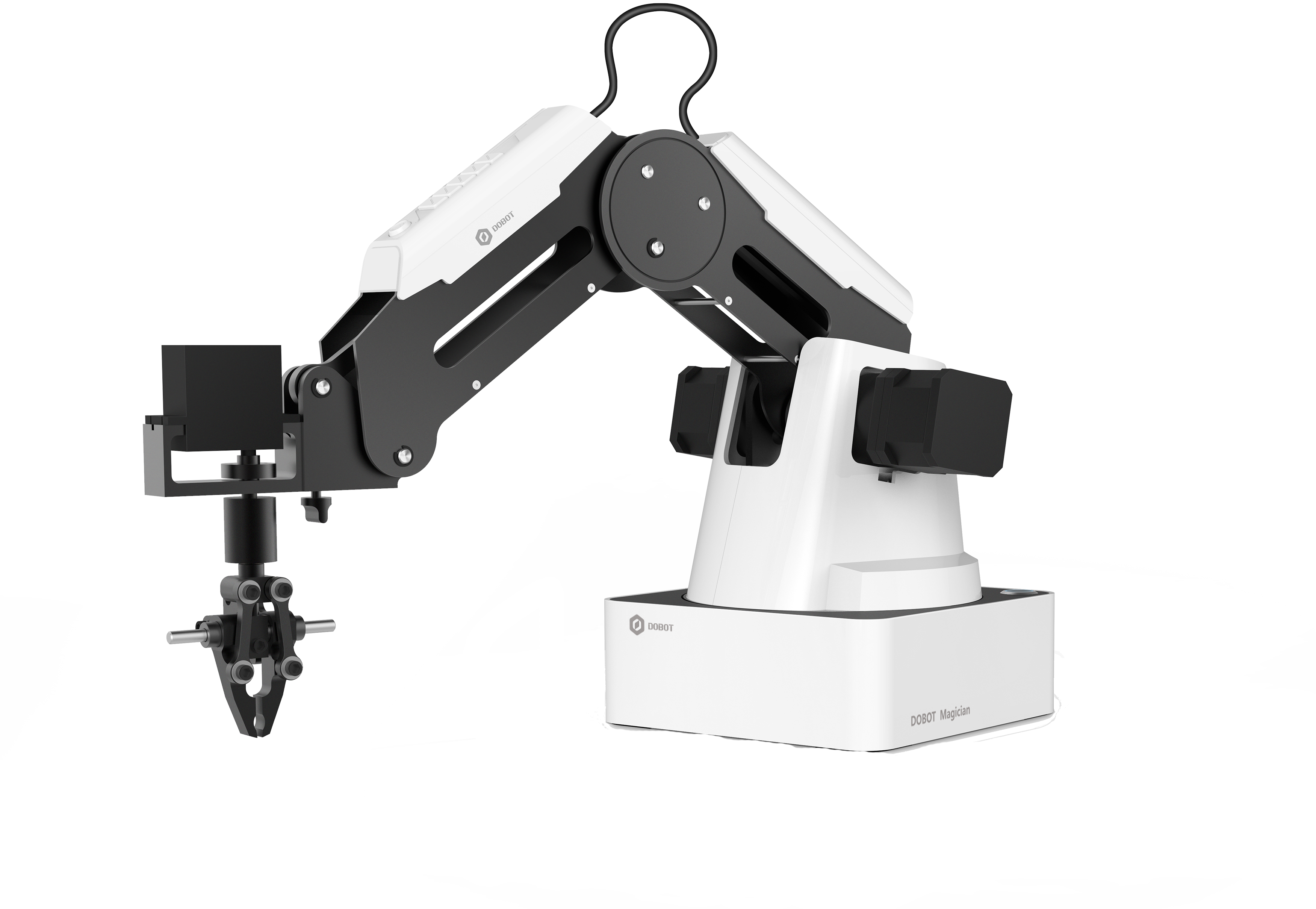
Dobot Magician Robotic Arm – Advanced Educational Plan
A complete, classroom-ready 4-axis robotic arm STEAM lab — one Dobot Magician V3 plus every tool head, wireless control, and a full year of K-14 curriculum, supplied and supported by RobotLAB.
From $1,995 purchase
.png)
AgileX Agriculture
AgileX Hunter 2.0 Rover
A high-payload, Ackermann-steering UGV platform that lets research teams and integrators prototype real autonomous-driving behavior on a car-like chassis.
From $12,800 purchase
Robotis Robot
Darwin OP2 Robot
An open-platform, fully programmable miniature humanoid with 20 metal-geared DYNAMIXEL joints and an onboard PC, built for hands-on robotics research and advanced STEM education.
Contact Us