
Uncategorized
Warehouse Automation in Miami: How Autonomous Mobile Robots Are Solving the Real Labor Problem in South Florida Distribution Centers
How hospitality operators evaluate, deploy, and scale commercial robots.
Tell us your industry and we'll recommend 3-4 robots to shortlist.
We evaluate, certify, and service every robot we sell.
From marketing, sales, demonstrations, and proof-of-concepts through deployment, training, support — and even repair. Local teams, local inventory, same-day service.
The first and only commercial robotics & AI franchise in America.
Sent by email within hours. 14-day review period. No obligation.
By Elad Inbar, RobotLAB founder & CEO — a practical guide to adopting robotics that actually delivers ROI.
About the book →Discover how K–12 teachers are using AI to personalize learning, reduce paperwork, and spark creativity in the classroom. From real-time feedback to interactive robotics, AI empowers educators to focus on students while building future-ready skills.
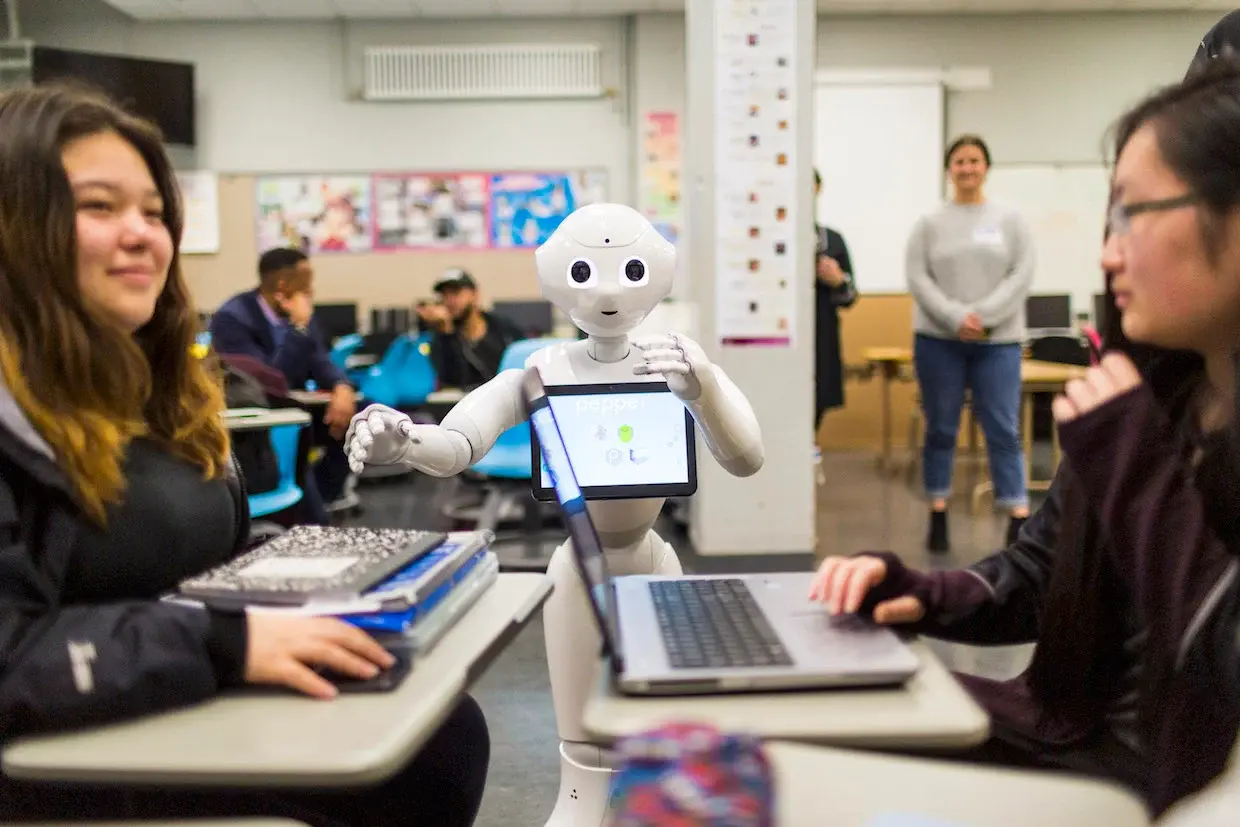
Artificial Intelligence (AI) is no longer just a buzzword—it’s transforming education in real and meaningful ways. From personalized lessons to reduced workloads, teachers are discovering that AI is more than a tool; it’s a partner in shaping the future of learning.
At its best, AI doesn’t replace teachers—it amplifies their impact. Let’s dive into how educators are using AI in K–12 classrooms to empower students and make teaching more effective.
Every student learns differently. Traditional classroom models can make it difficult to meet diverse needs, but AI is bridging that gap.
Adaptive learning platforms: Tools like DreamBox, Khan Academy, and other AI-driven platforms analyze student performance in real time, adjusting lessons so learners get the right level of support or challenge.
Instant feedback: AI-powered writing assistants highlight grammar, style, and clarity issues, giving students immediate insights while helping teachers track growth over time.
Language inclusivity: In multilingual classrooms, AI translation and speech recognition tools make lessons accessible for English language learners without slowing the pace of instruction.
The result? More engaged students, fewer left behind, and teachers who can spend less time reteaching and more time mentoring.
Teachers often spend up to 50% of their work hours on administrative tasks, from grading to communication. AI is changing that by taking on the “busy work” and freeing teachers to focus on human connection.
Automated grading: AI can instantly grade multiple-choice quizzes and even evaluate short-answer responses, saving hours of repetitive work.
Lesson planning assistants: By inputting a learning objective, teachers can generate draft lesson plans, activity ideas, and assessments in minutes.
Streamlined communication: AI chat tools help answer routine parent inquiries or translate updates into multiple languages, ensuring families stay informed.
This shift allows teachers to reclaim time for creativity, collaboration, and building meaningful student relationships.
One of the most exciting aspects of AI in education is its ability to spark imagination.
Robotics in the classroom: Students can program robots to complete challenges, blending coding with problem-solving.
AI-assisted art and writing: Tools like generative design platforms allow students to create digital artwork, music, or stories, pushing the boundaries of traditional assignments.
Immersive simulations: Science experiments, historical events, and real-world problem-solving can all come to life through AI-powered simulations and virtual environments.
These innovations keep students engaged while encouraging curiosity and critical thinking—the hallmarks of lifelong learning.
The workplace of tomorrow will be defined by technology—and today’s students need to be ready. By introducing AI in the classroom, teachers aren’t just enhancing learning today; they’re building skills for the future.
Digital literacy: Students learn to evaluate AI tools, use them responsibly, and understand their limitations.
Problem-solving and collaboration: Project-based learning with AI encourages teamwork and creative solutions.
Ethical awareness: Teachers guide students on how to use AI ethically, from respecting intellectual property to recognizing and mitigating bias.
By preparing students for the digital economy, teachers ensure they can thrive in jobs that may not even exist yet.
Of course, with any new technology, concerns arise. Some worry that AI might depersonalize learning or create overreliance on automation. Teachers are addressing these challenges head-on:
Maintaining balance: AI supports, but does not replace, teacher-led instruction. The human connection in education remains irreplaceable.
Privacy and data security: Schools are implementing policies to ensure student information is protected.
Bias in AI tools: Teachers are helping students critically examine AI outputs and understand that algorithms can reflect biases.
By approaching AI thoughtfully, educators ensure it remains a tool for empowerment rather than a source of inequity.
At RobotLAB, we believe teachers are at the heart of innovation. Our mission is to provide educators with AI-powered tools, hands-on robotics, and professional development that make technology integration seamless and effective.
From lesson-ready robots to training workshops, we help teachers feel confident using AI to enrich learning, engage students, and prepare them for a tech-driven world.
Together, we’re not just teaching students—we’re inspiring the next generation of innovators.
✨ Bottom Line: AI doesn’t replace teachers. It amplifies their impact—giving them the tools to personalize learning, cut down on administrative work, and spark creativity while preparing students for the future.
You choose which categories of cookies are stored on your device. Strictly-necessary cookies are required for the site to function and cannot be disabled. Read more in our Privacy Policy.
Session, security, and the consent record itself. Required for the site to operate.
First-party tracking (Mautic, on t.robotlab.com) so we understand which pages and products visitors engage with and improve the site over time.
Advertising pixels (Google Ads, Meta Pixel) used to measure ad performance and show relevant ads on partner sites. Turning this off opts you out of CCPA "sale" of personal information.