
How One Robot Per Restaurant Can Increase Profitability by 40 Percent
Nov 25, 2025
America’s family-style dining chains have secured a special place in our culture. They’re woven into our memories with familiar comfort food, friendly service, and that unmistakable feeling of stepping back into simpler times. Yet beneath that charm lies a challenge shared across nearly every segment of the restaurant industry: margins so thin that even strong sales barely move the financial needle.
Many well-known casual dining brands operate on margins hovering around just one to two percent. For operators living inside those numbers, profitability isn’t a matter of selling more. It’s a matter of keeping more of what they already earn. And despite the constant push toward redesigns, rebrands, or refreshed menus, the most immediate and cost-effective path to better financial performance may be far simpler.
It starts with adding just one service robot.
The $17 Million Opportunity Nobody Saw Coming
Within a national family-style dining chain of roughly 600 locations, RobotLAB’s regional leadership ran a straightforward modeling exercise: what would happen if each store added a single service robot? The results were far more significant than expected.
One restaurant robot dedicated to food running, bussing, and other repetitive support tasks can reclaim hundreds of labor hours at each restaurant every month. Multiply that across the entire system, and the regained time scales into more than 1.5 million hours a year. Using a conservative average hourly wage, that equates to an estimated $16.9 million in direct profit improvement. In practical terms, it reflects more than a 40 percent increase in net income — achieved without raising prices, extending hours, or selling even one additional entrée.
For operators used to living on razor-thin margins, this shift isn’t just helpful. It’s transformational.
Why Robots Work — and Why Guests Respond So Well
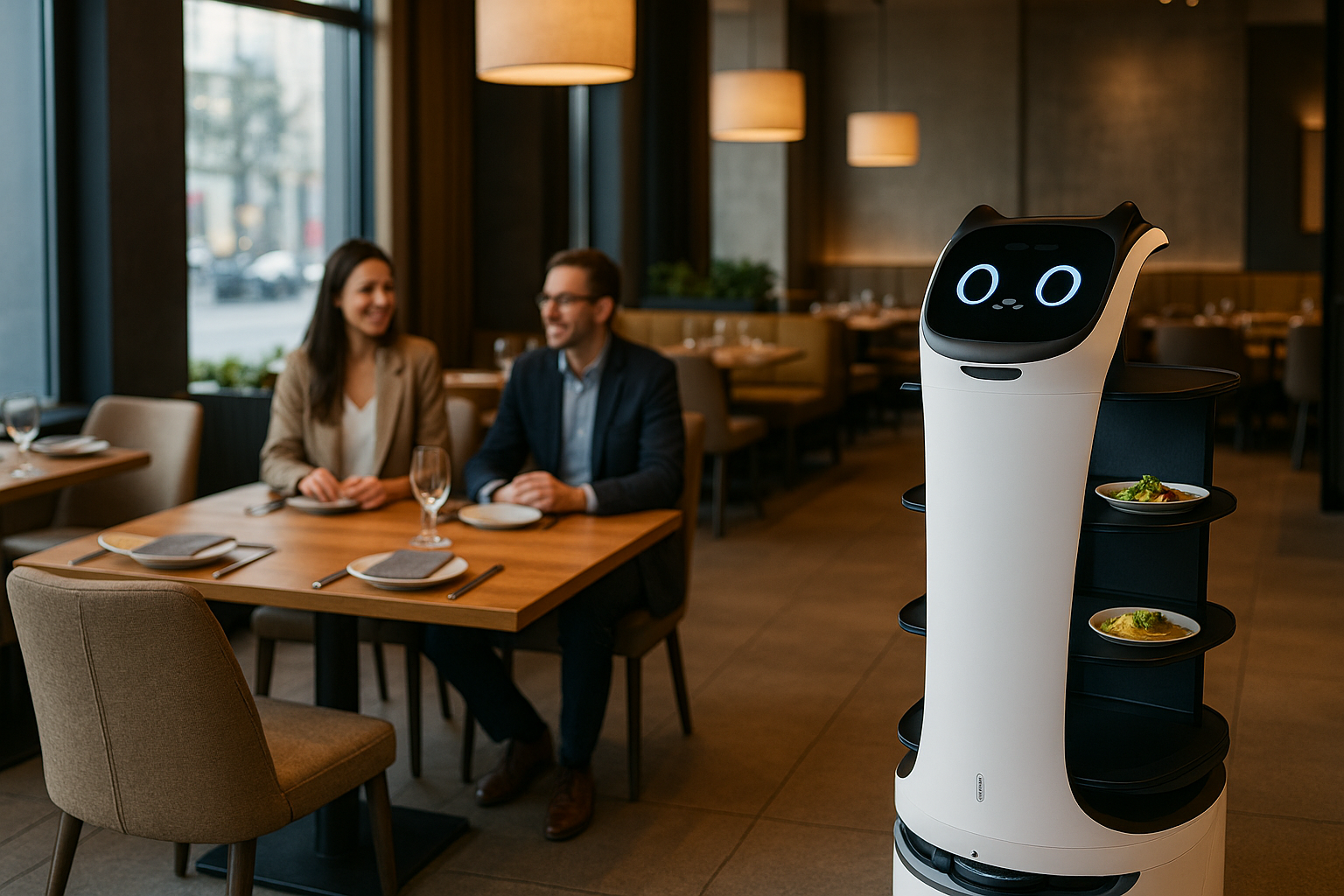
A persistent misconception lingers in the background: the idea that robots replace people. In reality, robots replace tasks, not team members. They take over the duties that pull employees away from the heart of hospitality.
In family-style dining, servers spend an extraordinary amount of their shift walking between the kitchen and dining room, carrying heavy trays, clearing and resetting tables, tracking down condiments and refills, and performing time-consuming tasks that add effort but rarely add to the guest experience. Robots absorb those responsibilities, giving staff the freedom to focus on what humans do best: connecting with guests, personalizing service, creating memorable moments, and staying calm even during the busiest peak periods.
Robots never call in sick, never arrive late, and never burn out on a Saturday night. They simply show up and support the team. Guests respond to them with surprising enthusiasm. Families often treat robots as part of the entertainment, adding an element of delight to the dining room. That emotional lift may be hard to quantify, but operators see its impact on reviews, return visits, and table-side conversations every day.
Rethinking the Financial Picture
To understand the significance of this opportunity, consider a typical casual dining chain with billions of dollars in annual revenue, yet net income that sits only in the low tens of millions. With margins that tight, even small operational improvements make a difference, but a systemwide efficiency shift driven by service robots can reshape the financial landscape.
Revenue remains unchanged; nothing about the menu or brand proposition needs to shift. Yet net income climbs dramatically once labor hours are reclaimed through automation. A profit increase approaching $17 million is suddenly attainable without a single change to customer-facing operations. The restaurant still feels warm and familiar, but behind the scenes, the workflow becomes faster, more reliable, and far more resilient to staffing challenges.
Profit Comparison Snapshot
|
Metric |
Before Robots |
After Robots |
|
Revenue |
Unchanged |
Unchanged |
|
Net Income |
Baseline (thin margin typical of casual dining) |
+40% improvement driven by reclaimed labor hours |
|
Profit Increase |
— |
~$17 million gain |
A Stronger Operation — Not Just a Cheaper One
While the financial gains are compelling, the stronger argument for many operators is the stability that robots bring to the dining room. Employees experience less physical strain and tend to stay longer. Table turns accelerate naturally without adding stress to servers. Short-staffed shifts no longer trigger crisis mode because robots maintain consistency during even the heaviest rushes.
Every robot also provides valuable data about service flow, congestion points, and patterns on the dining-room floor — insights that most operators have never had visibility into before. The result is a restaurant that runs more smoothly, a team that operates with less friction, and a guest experience that feels effortless.
As RobotLAB’s leadership often puts it: this isn’t science fiction. It’s sound business logic. Automation doesn’t replace hospitality; it protects it.
A Smart Rollout That Starts Small
A systemwide deployment doesn’t need to feel overwhelming. The most successful chains begin with a tightly controlled pilot of about ten locations, using it to gather real-world data on labor savings, uptime, staff adaptation, guest sentiment, and workflow adjustments. Once the initial learnings are clear, operators refine layouts, adjust server patterns, and develop best practices for a broader rollout.
With a strong pilot, many restaurants see measurable financial impact within 90 days. From there, the rollout can expand regionally and eventually nationally over 24 to 36 months — funded entirely by the efficiencies the robots generate.
The Bottom Line: Growth Doesn’t Always Come From Selling More
Family-style dining brands already possess what most industries envy: deep customer loyalty, strong brand identity, and a warm, memorable experience built on genuine service. They don’t need dramatic reinventions to grow.
They simply need to run smarter.
By adding a single service robot per store, operators can unlock more than a 40 percent improvement in profitability while elevating hospitality, strengthening workflows, enhancing team morale, and offering guests a unique, delightful touch they’ll remember long after the meal ends.
Sometimes the best way to grow isn’t by adding more. It’s by wasting less.






 Too much to read? Don't have time?

.webp?width=124&height=124&name=image%20(1).webp)
.webp?width=169&height=87&name=image%20(2).webp)