
Uncategorized
How School Districts Run Cleaning Robots Every Night
A K-12 facilities director walkthrough. Where autonomous robots run, where custodians stay, and how the overnight schedule actually…
How hospitality operators evaluate, deploy, and scale commercial robots.
Tell us your industry and we'll recommend 3-4 robots to shortlist.
We evaluate, certify, and service every robot we sell.
From marketing, sales, demonstrations, and proof-of-concepts through deployment, training, support — and even repair. Local teams, local inventory, same-day service.
By Elad Inbar, RobotLAB founder & CEO — a practical guide to adopting robotics that actually delivers ROI.
About the book →Learn how to build a compelling robotics automation business case that gets executive buy-in. Includes ROI frameworks, pilot strategies, and real-world examples.
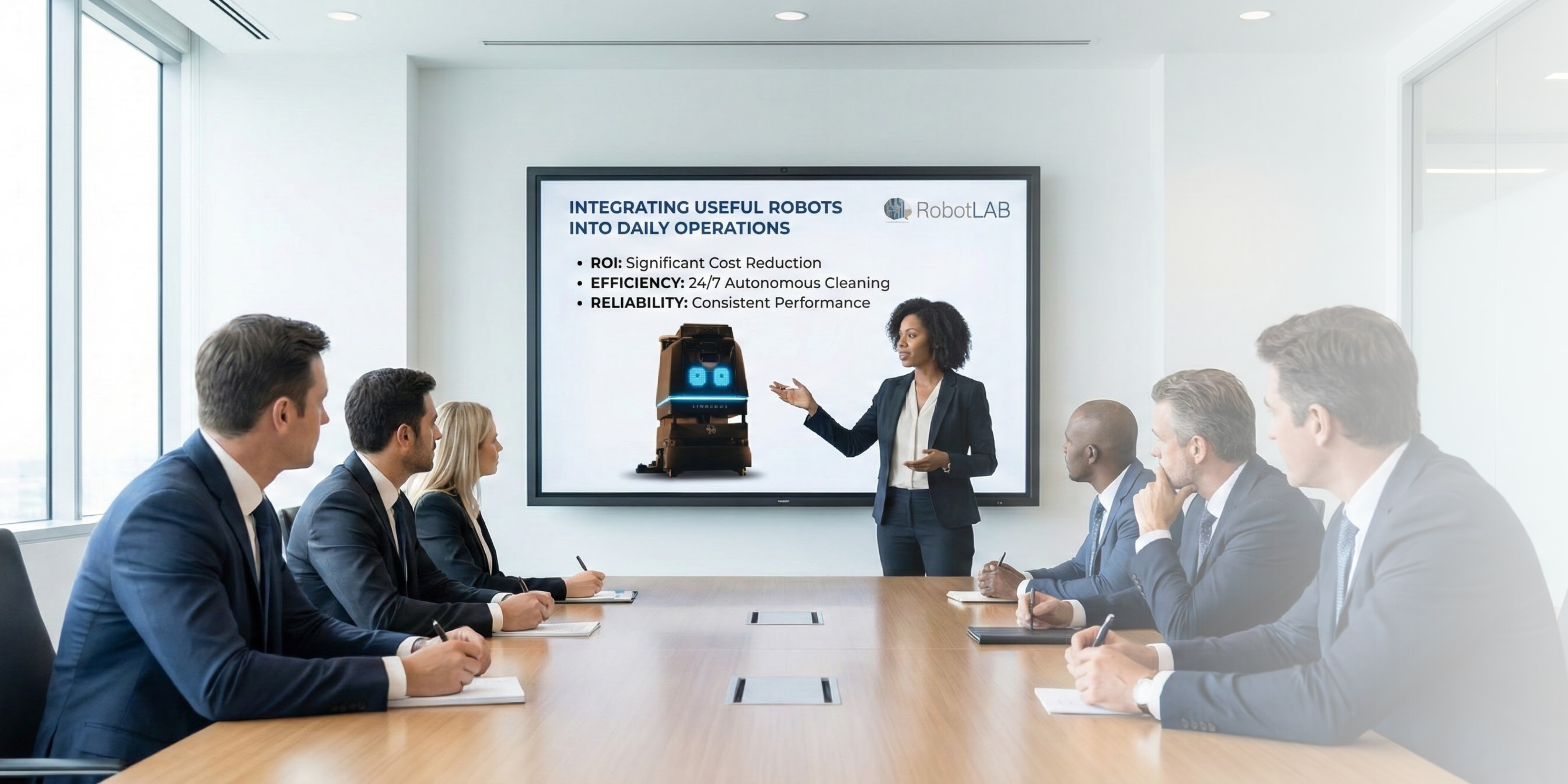
As an operations leader, you feel the pressure long before executives do. You watch teams rush through demanding shifts, see service quality slip during peak periods, field customer complaints, manage constant staffing gaps, and absorb the weight of every operational breakdown.
You know exactly where the friction is. You understand the root causes. You probably already see where robotics automation could help.
But recognizing the need is only half the challenge. The other half is getting leadership buy-in.
This guide provides a practical framework for building a business case that resonates with executives and secures the approval you need to start your robotics journey.
The story sounds similar across industries:
Hospitality: Housekeeping directors face workforce constraints, constant turnover, and rising guest expectations.
Logistics: Warehouse supervisors struggle with long walking distances, repetitive material movement, and overtime fatigue.
Food Service: Restaurant managers watch servers walk miles each shift just to keep up with demand.
Healthcare & Education: Chief engineers deal with maintenance backlogs, aging infrastructure, and limited staffing.
Facilities: Security teams monitor expansive campuses with shrinking headcounts while facility managers juggle tight schedules and increasing workloads.
As one facilities director put it: “The expectations go up, but my tools stay the same.”
A hospitality operations lead added: “We need help. People are tired. The work never stops.”
The problems are universal—and they’re getting harder.
Most leadership teams aren’t ignoring these issues. They simply evaluate decisions through a different lens, focusing on:
To secure approval, you need to speak their language. A strong business case addresses these concerns while grounding the narrative in your real operational experience.
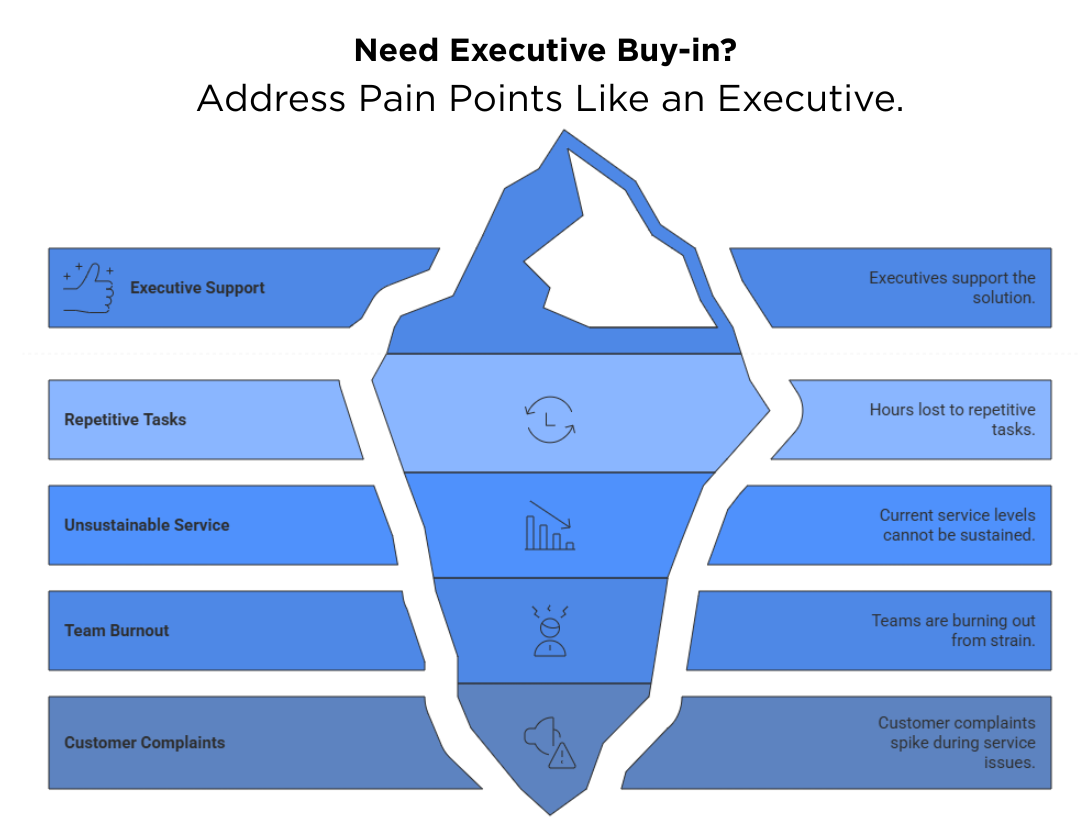
Here’s a proven framework used by organizations across hospitality, education, retail, logistics, healthcare, and large venues. It balances operational reality with financial clarity.
Executives need to feel the urgency before they’ll support a solution.
Frame the problem clearly:
Leadership responds when operational pain is clearly stated and backed by specific observations from your environment.
Once the problem is clear, connect it to specific robotic use cases. Executives want to understand fit, not theory.
Industry Examples:
Hotels: Autonomous scrubbers clean lobbies and corridors overnight, allowing staff to focus on rooms and guest experience.
Restaurants: Delivery robots reduce server steps, speed up food delivery, and ease peak-hour pressure.
Warehouses: AMRs (Autonomous Mobile Robots) move goods between docks, storage, and picking zones while reducing forklift dependency.
Healthcare: UV disinfection and logistics robots support infection control and routine supply delivery.
Educational Campuses: Cleaning robots assist custodial teams with daily coverage, special events, and summer projects.
Convention Centers: Robotics shorten room turnover times, improve readiness, and reduce overtime costs.
Connect the dots clearly:
Problem → Impact → Robotic Solution → Expected Outcome
Leadership moves faster when they see numbers, not opinions.
Field deployments across industries show measurable results:
Even if your numbers are estimated, providing a clear range makes robotics feel real and credible.
Executives care about safety, retention, and company culture.
Your message should be simple: Robots lift the load. People elevate the experience.
Highlight these benefits:
As one manager put it: “Robots take the strain so my team can focus on what really matters: experience.”
Leaders gain confidence when they see peer adoption.
Point to real-world examples:
The message is clear: This isn’t experimental. This is already working in environments as demanding as ours.
Executives respond well to controlled pilots that minimize risk.
A strong pilot proposal includes:
This approach lowers perceived risk and gives everyone a chance to see live results.
Teams that successfully adopt automation aren’t just buying robots—they’re choosing a partner.
Operations leaders consistently look for:
Operational Understanding
A partner who starts by listening and mapping your workflow, not forcing a product into the wrong problem.
Manufacturer-Agnostic Solutions
Your environment is unique. The right partner selects from multiple manufacturers to tailor solutions instead of pushing a single catalog.
Local Support With Last-Mile Service
Trust increases when help is nearby. Local presence matters for training, deployment, and ongoing service.
Preventive Maintenance & Quick Response
Downtime is a primary concern. Look for spare parts inventory, proactive maintenance, and fast response times.
Hands-On Deployment & Staff Coaching
You should never be left alone with a manual. The partner should be on-site for mapping, configuration, staff training, and available for follow-up support.
A strong partner reduces uncertainty, builds executive confidence, and accelerates adoption.
A clear ROI model transforms a good idea into a business decision. A simple estimator should help you quantify:
When you walk into a leadership meeting with these numbers, the conversation shifts from “why robots?” to “when do we start?”
Different organizations budget differently. Flexibility makes buy-in easier.
Common options include:
This allows you to match the financial model to your budget cycle instead of waiting for the perfect capital window.
Two questions arise in almost every discussion:
The right partner should provide:
This gives leadership confidence that robots will support operations, not introduce new risk.
Every sector is moving toward automation. The organizations that benefit most are those where frontline leaders raise their hands early, frame problems clearly, and bring structured plans to the table.
You see the problems every day.
You know where the gaps are.
You’re in the best position to guide your organization toward smarter, more sustainable operations.
Cleaning Robots ROI Masterclass
A video walkthrough covering how to evaluate labor costs, coverage areas, payback periods, and long-term value for robotics investments.
Cleaning Robots ROI Calculator
An Excel template you can use to input your own labor rates, coverage assumptions, and operating hours to estimate savings and compare scenarios.
While these examples focus on cleaning, the same structure adapts to other automation use cases including delivery, logistics, security, and guest experience.
RobotLAB supports teams across industries with robotics solutions for cleaning, delivery, logistics, guest experience, and security. With hands-on onboarding, training, fleet management tools, and local service, organizations can modernize operations while supporting the people who keep everything running.
If you’re ready to:
RobotLAB is here to help. Let’s build your business case and your roadmap together.
Contact RobotLAB to explore what robotics automation could do for your operation.
A K-12 facilities director walkthrough. Where autonomous robots run, where custodians stay, and how the overnight schedule actually…
How K-12 districts add autonomous cleaning without a capital bond. Real district proof, per-scrubber capacity, and how to…
quick summary of what the content is
Lidia is an AI assistant. This conversation is stored and shared with the RobotLAB sales and support teams. Privacy policy
Chatting as · Not you?
You choose which categories of cookies are stored on your device. Strictly-necessary cookies are required for the site to function and cannot be disabled. Read more in our Privacy Policy.
Session, security, and the consent record itself. Required for the site to operate.
First-party tracking (Mautic, on t.robotlab.com) so we understand which pages and products visitors engage with and improve the site over time.
Advertising pixels (Google Ads, Meta Pixel) used to measure ad performance and show relevant ads on partner sites. Turning this off opts you out of CCPA "sale" of personal information.