
Uncategorized
How School Districts Run Cleaning Robots Every Night
A K-12 facilities director walkthrough. Where autonomous robots run, where custodians stay, and how the overnight schedule actually…
How hospitality operators evaluate, deploy, and scale commercial robots.
Tell us your industry and we'll recommend 3-4 robots to shortlist.
We evaluate, certify, and service every robot we sell.
From marketing, sales, demonstrations, and proof-of-concepts through deployment, training, support — and even repair. Local teams, local inventory, same-day service.
By Elad Inbar, RobotLAB founder & CEO — a practical guide to adopting robotics that actually delivers ROI.
About the book →Discover how social robots like Temi and Pepper alleviate loneliness in senior care, enhance staff efficiency, and transform the future of healthcare.
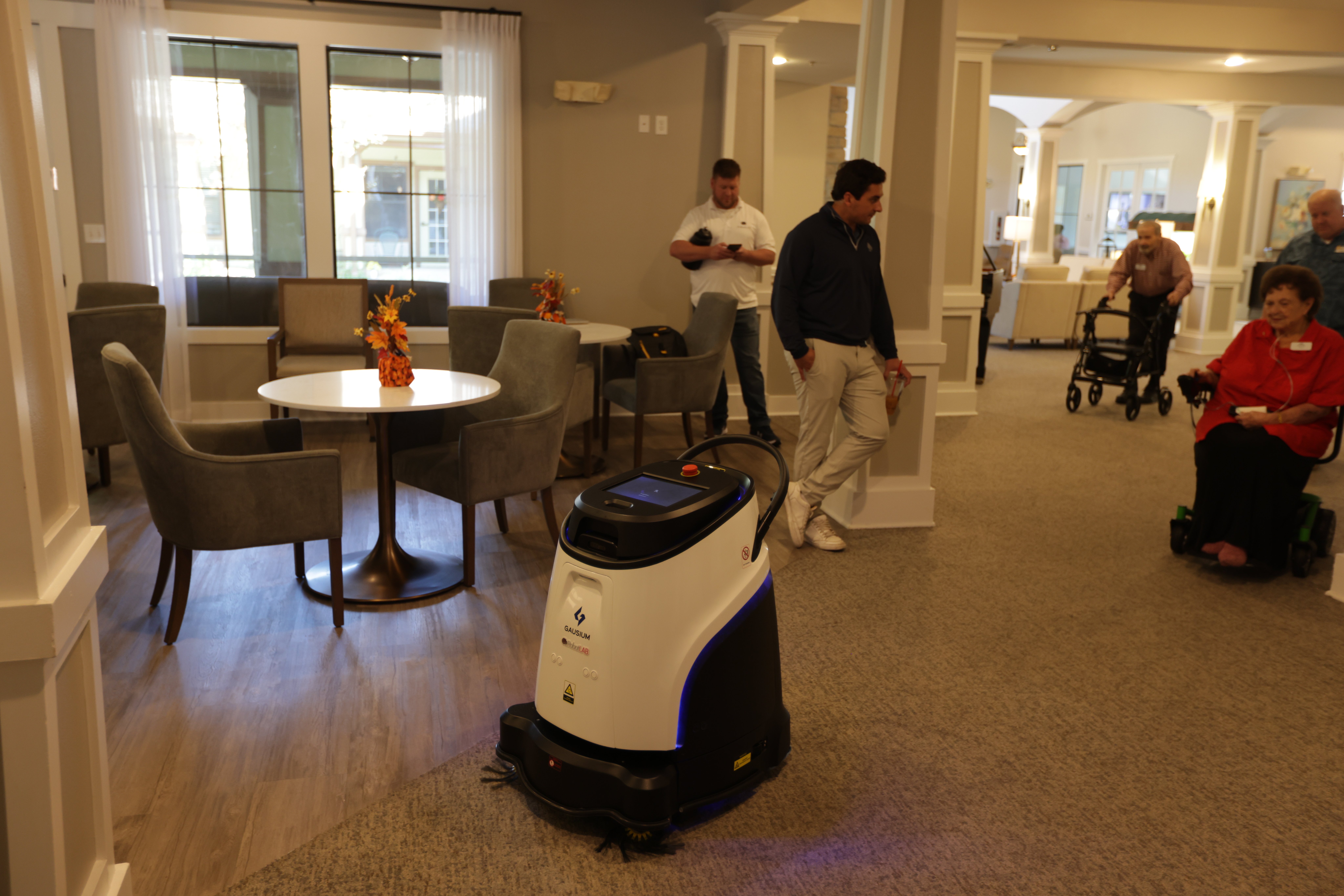
Senior living communities around the world are grappling with a dual challenge: residents are lonelier than ever, and caregivers are stretched thin. According to the National Academies of Sciences, Engineering and Medicine, one out of every four adults aged 65 and older is socially isolated. Loneliness is more than a fleeting emotion—it is linked to higher risks of heart disease, cognitive decline and even premature death. At the same time, long‑term care facilities face chronic staffing shortages. Front‑line staff often lack the bandwidth to deliver the one‑on‑one interactions that preserve dignity and mental health for residents with dementia and other disorders.
For residents, a typical day can be painfully monotonous. Many older adults spend hours in their rooms waiting for a busy nurse to deliver medication or provide assistance. Families may visit infrequently, leaving residents disconnected from the outside world. Studies estimate that isolation increases the risk of dementia by up to 50 percent and is associated with higher rates of depression and mortality. Complicating matters, long‑term care operators report difficulty filling entry‑level roles; high turnover rates create a vicious cycle where caregivers have even less time to engage each individual. This environment fosters boredom, anxiety and restlessness among residents, which in turn demands more staff attention—an unsustainable cycle.
Robots are emerging as a complementary solution to this crisis. Socially assistive robots are designed to interact with people, providing conversation, games, exercise prompts and companionship. Devices like ElliQ—an interactive table‑top robot—and Joy for All robotic pets have been used to stimulate memory and encourage seniors to reach out to loved ones. These robots are not meant to replace human caregivers; instead they offer a consistent presence, remind residents to take medications, and can even facilitate video calls with family. Early studies indicate that older adults respond positively when the robot’s behavior is personalized, and they see the robot as a friendly companion rather than a device.
In the United Kingdom, researchers tested the humanoid robot SoftBank Pepper in several care homes. Participants used Pepper for up to 18 hours across two weeks. The trial reported significant improvements in mental health and a measurable reduction in loneliness; residents engaged in conversation, games and music sessions with Pepper. Experts involved in the study noted that robots like Pepper could help alleviate loneliness and lighten the burden on staff because the robots continue interacting when caregivers are unavailable. Similarly, a case study at the Vienna dental institute Sleep & Smile documented how Pepper greets patients using facial recognition, guides them through their appointments, and plays interactive stories to reduce anxiety. Over 300 patient interactions per day were recorded, and staff reported reduced workloads and better patient experiences.
Beyond humanoids, telepresence robots such as Temi allow families to stay connected with residents when physical visits are impossible. During COVID‑19 lockdowns, a German hospital introduced Temi robots for virtual visitation. Researchers found that regular video calls via Temi dramatically reduced feelings of loneliness among patients and care‑home residents; many participants even saw Temi as a member of their community. The robots’ ability to autonomously navigate hallways and call specific rooms enabled staff to schedule spontaneous visits without leaving their posts.
One of the most accessible robots for senior living is the Temi robot. Priced around $3,999 USD and available through RobotLAB, Temi pairs high‑end functionality with affordability. The sleek robot features an autonomous mobile base, a voice‑activated interface and a 10‑inch touchscreen. Temi can follow residents as they move about, call family via video conference and deliver personalized reminders. A docking station keeps the unit charged so it can operate throughout the day.
For care facilities facing budget constraints, Temi’s low monthly financing cost (as little as $83 per month) makes deployment feasible. The robot’s ability to integrate virtual meetings means families can schedule check‑ins without requiring staff to set up tablets or hold phones. Temi supports multiple languages and can be programmed with games or cognitive exercises tailored to each resident’s needs.
Social robots offer more than friendly conversation. On RobotLAB’s memory‑care capability page, the company explains that assistive robots provide cognitive stimulation through games and storytelling, offer sensor‑based interaction to monitor vital signs, and send alerts to caregivers if someone is at risk. Implementing memory‑care robots has been shown to enhance patient engagement, improve cognitive function, increase social interaction and reduce loneliness. Because the robots can learn residents’ preferences, they adapt their activities, whether playing favorite songs or suggesting exercises—to match individual interests. This personalization increases adherence to therapy and improves overall mood.
Successful integration of social robots requires thoughtful planning. Care providers should involve residents and families in the decision to adopt robotics. Staff need training to operate and maintain the robot; they should also understand its limitations. Robots are best used to complement, not replace, human interaction. Facilities might start with short trial periods during which the robot visits common areas and engages multiple residents at once. Feedback from those interactions can inform programming adjustments.
Privacy and ethical considerations must also be addressed. Residents should control when the robot listens, records or transmits data. Clear consent policies help build trust. Fortunately, many modern robots, including Temi, offer robust privacy settings and encrypted communication.
The future of senior care will be a hybrid of human compassion and smart technology. As social robots like Temi become more capable and affordable, care facilities have a unique opportunity to enrich residents’ lives and ease the burden on hardworking caregivers. By embracing innovation today, communities can create a more connected, supportive environment where older adults thrive.
A K-12 facilities director walkthrough. Where autonomous robots run, where custodians stay, and how the overnight schedule actually…
How K-12 districts add autonomous cleaning without a capital bond. Real district proof, per-scrubber capacity, and how to…
quick summary of what the content is
Lidia is an AI assistant. This conversation is stored and shared with the RobotLAB sales and support teams. Privacy policy
Chatting as · Not you?
You choose which categories of cookies are stored on your device. Strictly-necessary cookies are required for the site to function and cannot be disabled. Read more in our Privacy Policy.
Session, security, and the consent record itself. Required for the site to operate.
First-party tracking (Mautic, on t.robotlab.com) so we understand which pages and products visitors engage with and improve the site over time.
Advertising pixels (Google Ads, Meta Pixel) used to measure ad performance and show relevant ads on partner sites. Turning this off opts you out of CCPA "sale" of personal information.