
Uncategorized
Warehouse Automation in Miami: How Autonomous Mobile Robots Are Solving the Real Labor Problem in South Florida Distribution Centers
How hospitality operators evaluate, deploy, and scale commercial robots.
Tell us your industry and we'll recommend 3-4 robots to shortlist.
We evaluate, certify, and service every robot we sell.
From marketing, sales, demonstrations, and proof-of-concepts through deployment, training, support — and even repair. Local teams, local inventory, same-day service.
The first and only commercial robotics & AI franchise in America.
Sent by email within hours. 14-day review period. No obligation.
By Elad Inbar, RobotLAB founder & CEO — a practical guide to adopting robotics that actually delivers ROI.
About the book →Explore how autonomous delivery robots boost restaurant efficiency by saving time, reducing labor costs, and improving service. Discover RobotLAB’s Servi.
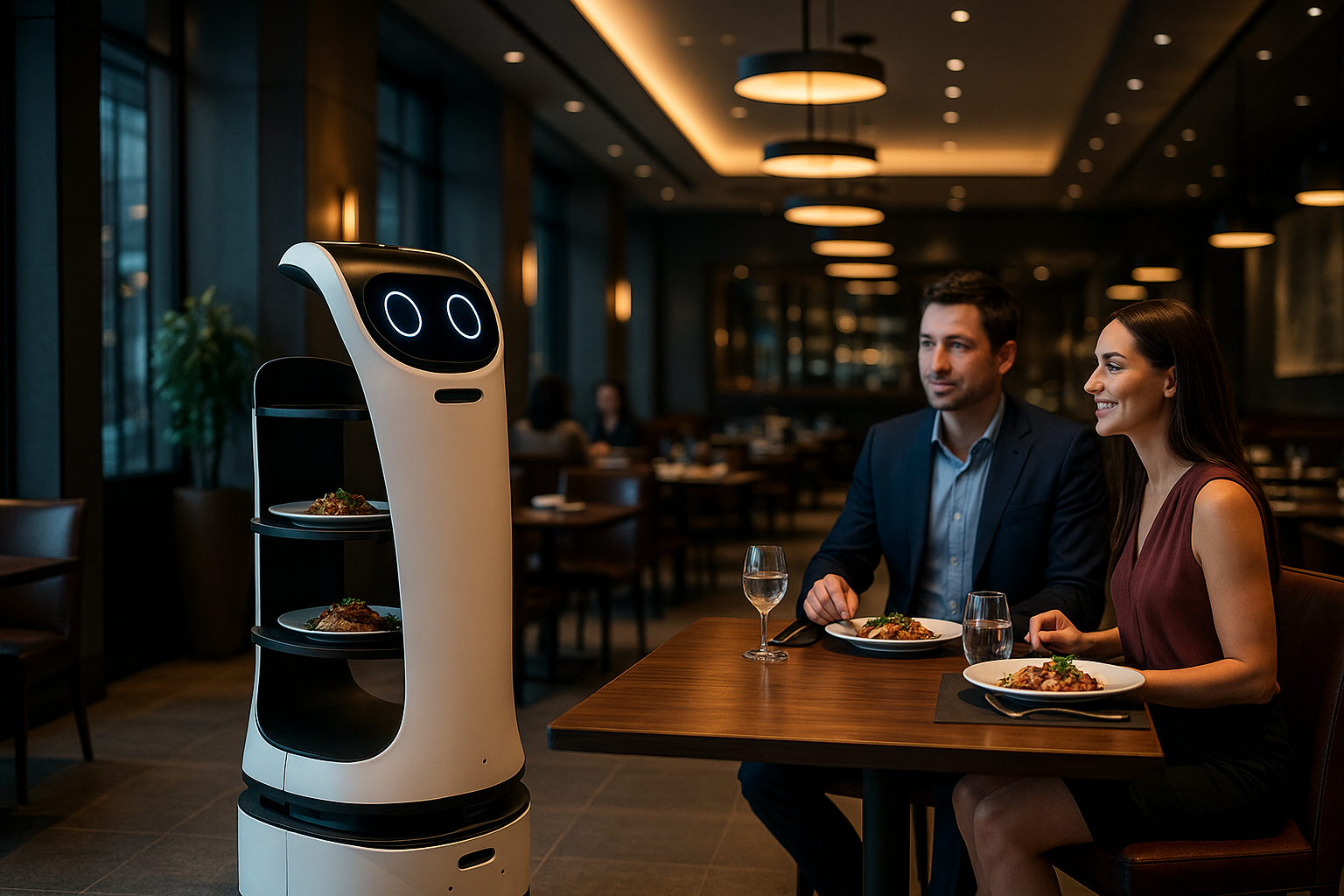
The hospitality industry is facing a new reality: the pressure to operate faster, leaner, and smarter than ever before. Gone are the days when you could solve a bottleneck simply by adding more bodies to the floor. Today’s most successful restaurateurs are turning to a game-changing solution to slash overhead and maximize throughput—autonomous service robots. Moving far beyond novelty, these tireless runners are now a necessity for protecting your margins. By handling the heavy lifting, running meals, and bussing dirty dishes, they eliminate the operational drag that kills efficiency.
The result? A frictionless dining room where your staff is free to focus on what actually drives revenue: guest connection and upselling.
Running a restaurant is hard work. Operators must juggle staffing, training, guest satisfaction, and rising costs while preserving thin margins. When dining rooms are busy, bottlenecks appear—servers travel hundreds of miles each shift and spend precious minutes walking back and forth to the kitchen. Mistakes such as wrong orders or spills erode profits and customer loyalty. A RobotLAB article on restaurant automation notes that robotic technology can simplify processes and save time across the operation. By deploying robots, restaurants can achieve:
Inventory time savings – Robots streamline back-of-house tasks and reduce the hours spent counting stock.
Simplified processes – Automation standardizes delivery routes and reduces complexity for staff.
Lower operational costs – Mechanical carriers work around the clock without overtime or extra benefits.
Fewer human errors – Consistent performance translates to fewer mistakes during service.
Reduced waste – Precise delivery minimizes spills and spoiled food.
Contactless delivery – Guests receive meals without direct physical exchange, a practice popularized during the pandemic.
Higher customer satisfaction – Faster, more reliable service frees employees to provide hospitality rather than merely running plates.
Robotic delivery systems also support new business models. Because they don’t get tired, robots can handle peak-hour demand without requiring additional staff. They navigate busy dining rooms, avoid obstacles, and notify guests when their orders arrive. According to RobotLAB, delivery robots carry meals to a designated point and then alert the customer via onboard screens or mobile notifications, making the process safer and more efficient.
Modern delivery robots combine mapping, navigation, and sensor technologies to move independently through restaurants. They use LiDAR and cameras to build 3D maps of their environment and adjust to changes in real time. In the article “The Rise of Restaurant Robotics,” RobotLAB explains that delivery robots, such as Bear Robotics’ Servi, transport food from the kitchen to guests’ tables, minimize manual labor, and allow staff to focus on guest engagement. Advanced path-planning algorithms and collision detection ensure smooth, reliable delivery without spills. With built-in trays and adjustable shelves, the robots can carry multiple orders at once and even return dirty dishes to the dishwashing area.
As labor shortages persist and turnover remains high, robots provide consistent performance 24/7. Unlike human employees, they don’t require breaks or sick days, which translates to reduced training and labor costs. By handling repetitive tasks, robots improve table turnover and overall efficiency. They’re also adaptable—some models can use elevators and push doors to deliver food across multiple floors.
RobotLAB offers several delivery robots, but one of the most popular models is Bear Robotics Servi. Servi is an autonomous service robot designed specifically for the hospitality industry. On its product page, RobotLAB describes Servi as a multifunctional service robot that “optimizes productivity and streamlines tasks” across hospitality, healthcare, and retail. In a restaurant setting, Servi efficiently delivers food and drinks, clears tables, and returns dirty dishes to the kitchen. By automating these repetitive tasks, Servi enables front-of-house staff to focus on personal interaction and service quality, enhancing the dining experience and reducing labor costs.
Servi is built for real-world environments. Its three-tiered trays can carry multiple plates, and its state-of-the-art sensors allow it to avoid obstacles and navigate tight spaces. It can be programmed with custom routes, integrate with point-of-sale systems, and even communicate with elevators for multi-floor delivery. Operators can monitor Servi’s performance through a web portal, adjust schedules, and track usage data to optimize labor allocation.
RobotLAB also offers the Servi+ (Servi Plus) for businesses needing higher capacity. Servi+ features larger trays, increased payload, and extended battery life, making it ideal for banquet halls and large venues. Both Servi and Servi+ are National Sanitation Foundation (NSF) certified, ensuring compliance with strict hygiene standards. For restaurants exploring automation, these robots provide a practical and proven entry point. Readers can learn more about Servi by visiting the official product page on RobotLAB’s website: Bear Robotics Servi.
Robots are no longer science fiction. In Our Robotics Future, Elad Inbar—CEO of RobotLAB—explains that robots are “a tangible reality reshaping industries across the globe.” He invites business owners and decision-makers to explore the transformative power of automation. The book serves as an essential guide for companies considering robotics. It demystifies the current robotics market, offers insights into emerging trends, and highlights how automation can help organizations enhance efficiency and address labor shortages. For restaurant operators, these insights underscore why delivery robots like Servi are more than a gimmick—they’re strategic tools for staying competitive.
Adopt automation strategically. Start by identifying high-frequency, low-value tasks—such as table running and dish returns—that can be automated without compromising guest interaction. Delivery robots relieve staff of these chores, enabling them to focus on personal service.
Improve efficiency and reduce costs. Robots don’t get tired or require breaks, which means consistent performance and higher throughput. By reducing labor requirements, restaurants can offset rising wages while maintaining service quality.
Enhance customer experience. Contactless delivery and reliable service minimize wait times and errors. With fewer trips to the kitchen, servers can spend more time upselling and building relationships with guests, driving higher tips and repeat visits.
Choose trusted partners. Work with reputable providers like RobotLAB. Their Servi and Servi+ robots are purpose-built for hospitality and backed by field experience. RobotLAB offers training, installation, and support to ensure successful deployment.
Educate your team. Share resources such as Our Robotics Future to build organizational understanding of automation’s potential. Engaged employees will be more likely to embrace robots as helpful colleagues rather than competition.
Autonomous food delivery robots aren’t a distant dream—they’re already transforming restaurants today. By tackling labor shortages, standardizing service, and improving operational efficiency, delivery robots offer a clear return on investment. With partners like RobotLAB and practical products like the Bear Robotics Servi, restaurateurs can embrace automation confidently and shape a future where human hospitality and robotic efficiency work hand-in-hand.
Ready to amplify your staff and transform your restaurant operations? Contact RobotLAB today to schedule a free consultation and discover how autonomous service robots can save your servers’ sanity while boosting your bottom line.
You choose which categories of cookies are stored on your device. Strictly-necessary cookies are required for the site to function and cannot be disabled. Read more in our Privacy Policy.
Session, security, and the consent record itself. Required for the site to operate.
First-party tracking (Mautic, on t.robotlab.com) so we understand which pages and products visitors engage with and improve the site over time.
Advertising pixels (Google Ads, Meta Pixel) used to measure ad performance and show relevant ads on partner sites. Turning this off opts you out of CCPA "sale" of personal information.